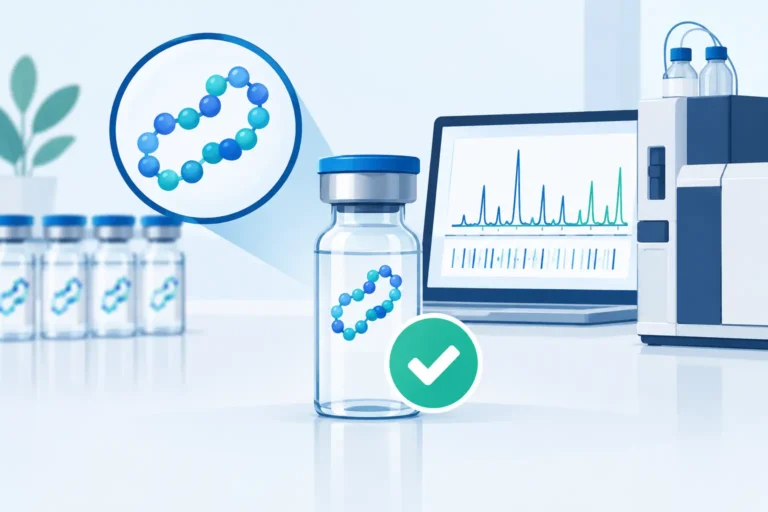
Research Compounds: What Quality Evidence Proves
A vial label can state a compound name, quantity, and purity percentage. None of those details, by themselves, establishes whether the material is fit for controlled laboratory work. Research compounds are only as dependable as the evidence behind their identity, composition, handling, and batch traceability. For researchers building reproducible in-vitro workflows, that distinction is not administrative. It directly affects the quality of the data.
A procurement decision should therefore begin before checkout. It should begin with a clear question: what documentation shows that this specific batch is what the supplier says it is? The strongest answer combines analytical testing, accessible records, defined quality controls, and clear research-use-only boundaries.
Why Research Compounds Require More Than a Purity Claim
Purity is a meaningful analytical measure, but it is not a complete quality system. A reported 99% purity result may describe the relative amount of a target peak under a defined method. It does not automatically confirm molecular identity, establish the nature of remaining impurities, verify endotoxin screening, or show whether the material being shipped corresponds to the test record reviewed by the buyer.
That does not make purity data unhelpful. It makes context essential. A serious supplier should be able to identify the analytical method used, connect results to a batch or lot, and provide enough documentation for the researcher to evaluate fitness for a particular non-clinical protocol.
For peptide research, this is especially relevant. Small differences in sequence-related impurities, degradation products, residual processing materials, or handling history can complicate interpretation. A result that appears unexpected may reflect the experimental system, but it may also be influenced by material characterization. Without documentation, the investigator is left guessing.
The practical standard is straightforward: do not treat a product page assertion as a substitute for batch-level evidence.
The Analytical Record Behind Defensible Procurement
A Certificate of Analysis, or COA, is often the first document researchers request. At its best, it is not a marketing attachment. It is a batch-specific record that identifies the material, reports defined test results, and gives the purchaser a basis for confirming that the delivered item aligns with the documented item.
COAs vary in depth. A useful record should include a recognizable lot or batch identifier, the compound designation, the stated quantity or concentration where applicable, analytical results, acceptance criteria when provided, and test or release dates. It should also be easy to retrieve when materials are being ordered repeatedly or compared across multiple lots.
Three forms of analytical evidence are particularly valuable when evaluating peptide research materials.
UHPLC Purity Screening
Ultra-high-performance liquid chromatography, commonly abbreviated UHPLC, provides a high-resolution view of a sample’s chromatographic profile. It is commonly used to estimate purity and identify whether detectable non-target peaks are present under the established method.
A purity value of 99% or higher can be a strong quality indicator when supported by clear testing practices. Yet researchers should avoid reducing an evaluation to one number. The method, reporting convention, batch association, and the specific needs of the planned assay all matter. A high-purity material remains more useful when its identity has also been independently confirmed.
Mass Spectrometry Identity Confirmation
Mass spectrometry addresses a separate question: does the observed molecular mass align with the expected compound? For research compounds, identity confirmation helps distinguish a documented material from one that merely carries the expected name on a label.
This distinction matters because chromatographic purity alone cannot fully establish molecular identity. A clean chromatographic profile is valuable, but it should be interpreted alongside orthogonal evidence. UHPLC and mass spectrometry answer different questions, and together they provide a more credible analytical foundation.
Endotoxin Screening
For controlled in-vitro work involving sensitive biological systems, endotoxin screening can be an important quality-control consideration. Endotoxins can introduce confounding variables that have nothing to do with the intended research compound, creating avoidable uncertainty in assay behavior.
Endotoxin screening does not convert a research material into a clinical, diagnostic, veterinary, therapeutic, or pharmaceutical product. It is a quality-control data point. Its value is in helping researchers assess potential experimental variables and maintain well-characterized input materials within a research-use-only setting.
Traceability Is Part of the Material
Researchers often focus on the vial and overlook the chain of records around it. That is a mistake. A compound without traceable documentation is not fully characterized from a procurement standpoint, regardless of how polished the label may appear.
Batch traceability connects the material in hand to its analytical record. It supports inventory control, repeat ordering, internal review, and investigation when results vary between experiments. If a laboratory needs to compare performance across lots, establish a retained-sample practice, or document inputs for a study record, the lot identifier becomes operationally significant.
A dependable procurement workflow should make it possible to retain four connected records: the product specification reviewed before purchase, the batch-level COA, the order record, and the laboratory’s internal receipt and storage documentation. Each has a distinct role. Together, they create a defensible chain from supplier selection to experimental use.
This is also why account-based COA access and order tracking are more than e-commerce conveniences. They reduce friction when a laboratory must locate a past record, verify what was received, or plan a repeat purchase around a particular material specification.
How to Evaluate a Supplier’s Quality Positioning
The most credible suppliers make quality claims that can be inspected. They state what testing is performed, identify the purpose of each method, publish or provide batch-level documentation, and maintain direct language about intended use.
Look for a supplier that can clearly address the following questions:
- Is purity assessed using an appropriate chromatographic method such as UHPLC?
- Is molecular identity confirmed using mass spectrometry?
- Are testing records connected to identifiable batches or lots?
- Is endotoxin screening addressed where relevant to the product’s quality-control program?
- Are COAs accessible before or after procurement through a clear process?
- Does the supplier explicitly define the materials as research-use-only and exclude human, veterinary, clinical, diagnostic, therapeutic, and pharmaceutical use?
The last question is a marker of responsible operation, not an afterthought. A supplier that blurs use boundaries creates compliance risk and undermines the research-first discipline that qualified buyers expect. Clear restrictions protect the integrity of the supply relationship and keep the material positioned for its intended controlled laboratory context.
Domestic testing and fulfillment can also matter, particularly when timing, documentation access, and communication are part of the procurement requirement. For U.S. laboratories, predictable shipping and responsive order visibility can reduce interruptions between material selection and experimental scheduling. Speed is useful, but it should not be mistaken for quality evidence. The right priority is documented quality first, dependable fulfillment second.
Selecting Research Compounds for the Actual Protocol
No universal purchasing checklist can replace protocol-specific judgment. A metabolic pathway study, a peptide stability assessment, and a cellular characterization experiment may each place different demands on material quantity, handling, documentation, and control design.
Before ordering, define the intended in-vitro use, required unit size, acceptable analytical documentation, storage plan, and lot-control needs. Consider whether the project requires multiple units from a single batch, whether a reference material or comparator is necessary, and whether the experimental timeline leaves room for receipt verification and internal documentation.
This is where standardized unit sizes and bulk procurement options can be useful. They support planning, but only when the laboratory can maintain clear lot segregation and records. Larger procurement is not automatically better. It depends on storage capabilities, anticipated consumption, stability considerations, and whether using one batch across a project provides a meaningful consistency advantage.
Irontide Labs positions its catalog around this evidence-based approach: independently tested, U.S.-based research materials supported by UHPLC screening, mass-spectrometry identity verification, endotoxin screening, and documented batch controls. For qualified researchers, the value is not simply access to a named compound. It is access to material that can be evaluated against the standards required for serious research procurement.
Build Confidence Before the Experiment Begins
Well-controlled research begins with well-characterized inputs. Review the COA. Confirm the lot. Understand what the reported purity result does and does not show. Verify that identity data and quality-control information match the needs of the work being planned.
When research compounds are selected on documented evidence rather than assumptions, the laboratory starts from a stronger position: fewer unknowns at receipt, clearer records during execution, and more confidence in the integrity of every result that follows.