Peptide COA Meaning for Serious Research Buyers
A peptide vial may carry a familiar name and a stated purity percentage, but neither is enough to support defensible research procurement. The peptide COA meaning comes down to evidence: a batch-specific record showing what was tested, how the material performed, and whether the documented results align with the requirements of the intended in-vitro work.
For qualified researchers, a Certificate of Analysis is not decorative paperwork. It is part of the material characterization record. When identity, purity, concentration, and contaminant controls are unclear, the uncertainty moves directly into the experiment. That can distort interpretation, complicate troubleshooting, and consume time that a properly documented batch could have protected.
Peptide COA Meaning: A Batch-Level Quality Record
COA stands for Certificate of Analysis. In peptide research procurement, it is the document that reports analytical findings for a specific lot or batch of material. A meaningful COA connects the tested sample to the product through identifiers such as the compound name, lot number, test date, and sometimes a sample or report number.
The distinction between a batch-specific COA and a generic specification sheet matters. A specification sheet describes the standard a material is expected to meet. A COA reports what a particular batch actually measured. Both can be useful, but they answer different questions. Researchers evaluating current inventory need evidence tied to the exact lot they intend to use.
A credible COA should make it possible to assess several basic points: whether the material identity was verified, what purity was measured, whether the reported result meets the stated acceptance criterion, and whether relevant safety or contamination screens were performed. It should also identify the test method clearly enough for a scientifically literate buyer to understand the strength and limits of the result.
The Core Fields to Review on a Peptide COA
The value of a COA is determined by the quality of the data behind it, not by the presence of a PDF. Start by confirming that the document identifies the material precisely. The product name, lot number, and date should be consistent with the label, order record, and inventory system. If a document cannot be tied to the vial or batch on hand, it offers limited traceability.
Identity confirmation
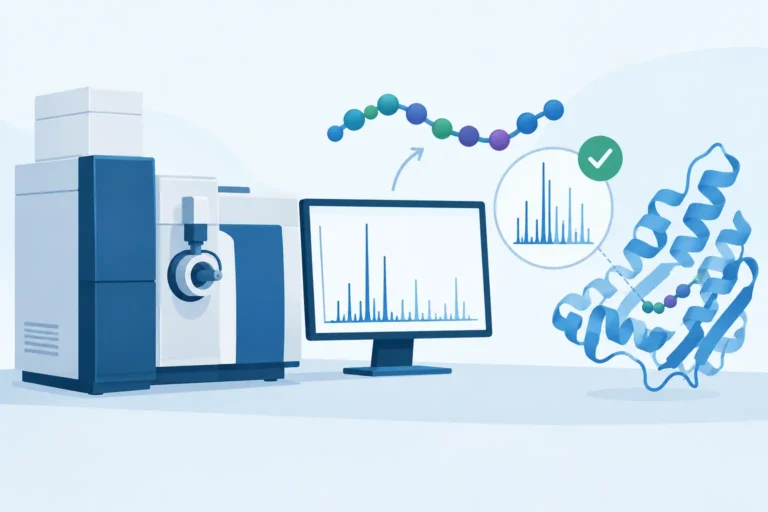
Peptides can have closely related sequences, similar names, and comparable chromatographic behavior. Identity confirmation addresses whether the material corresponds to the claimed molecular species. Mass spectrometry is commonly used for this purpose because it evaluates molecular mass and can provide strong evidence that the expected compound is present.
A mass-spectrometry result should be considered alongside the expected molecular weight, including the relevant salt form or modification where applicable. A reported mass that appears close but is not explained can indicate a different form of the compound, an adduct, incomplete synthesis, or a documentation problem. The right interpretation depends on the peptide and method, but unexplained mismatches deserve scrutiny.
Identity confirmation is not interchangeable with purity. A sample can contain the expected peptide while also containing meaningful levels of deletion sequences, synthesis-related impurities, or degradation products. Serious procurement review requires both answers.
Purity by UHPLC or HPLC
Purity is often the figure buyers notice first. For research peptides, high-performance liquid chromatography or ultra-high-performance liquid chromatography is commonly used to separate components and estimate the relative amount of the principal peak. UHPLC can provide higher resolution and faster analysis under appropriate conditions, making it valuable for peptide quality screening.
A stated result of 99% or higher may be a strong quality indicator, but the number should never be read in isolation. Confirm the analytical method, the stated purity result, and the acceptance specification. If a chromatogram is included, examine whether the main peak is well resolved and whether notable secondary peaks are visible.
It also depends on the purpose of the study. A highly sensitive characterization workflow may require more detailed impurity information than a preliminary controlled in-vitro screen. The key is to match the evidence package to the risk profile of the work, rather than assuming every purity percentage supports every application.
Quantitative analysis and content
Purity percentage and peptide content are related but distinct measurements. Purity describes the proportion of the chromatographic signal attributed to the target analyte under the test conditions. Quantitative analysis addresses how much analyte is present, often through assay, content, or concentration reporting.
This distinction becomes especially relevant when preparing research solutions. A vial labeled with a nominal mass does not eliminate the need for controlled handling, appropriate calculations, or study-specific verification. Residual moisture, salt content, counterions, and formulation details can affect how nominal mass translates into active peptide content.
When a COA includes quantitative data, review the reporting units and the basis of calculation. A clear report distinguishes values such as milligrams per vial, percent assay, or concentration. Ambiguous labels create avoidable uncertainty at the bench.
Endotoxin screening
Endotoxin screening addresses a separate quality dimension. Endotoxins are bacterial cell-wall components that can interfere with certain biological research systems, especially studies involving cells or immune-related pathways. A high purity result does not establish low endotoxin. These are different analyses with different implications.
A COA may report endotoxin results in endotoxin units per milligram or per vial, alongside a pass/fail criterion. Whether endotoxin testing is necessary depends on the experimental model and protocol. For many cell-based or sensitive in-vitro investigations, it is a material consideration rather than an optional extra.
A reported endotoxin result also does not make a research material suitable for human, veterinary, clinical, diagnostic, therapeutic, or pharmaceutical use. Those categories require separate regulatory, manufacturing, and quality-system controls beyond a research-use-only COA.
How to Evaluate a COA Before Procurement
Before placing an order or introducing a new lot into a study, review the document as part of a repeatable qualification process. First, match the compound name, lot number, and unit size to the item being purchased. Next, confirm that identity testing and purity analysis are reported with actual results, not merely a statement that testing was performed.
Then assess whether the test methods fit the claims. Mass spectrometry supports identity confirmation. UHPLC or HPLC supports purity screening. Quantitative methods support content claims. Endotoxin testing addresses a specific contamination concern. A supplier that presents these results separately is giving the buyer a clearer basis for evaluation than one relying on broad, unsupported language.
Finally, consider document accessibility and continuity. COAs should be available before or at the point of procurement and remain traceable after fulfillment. Account-based batch documentation and retained order records help laboratories connect incoming material to experimental records, deviations, and future reorders.
Irontide Labs positions COA access around independently tested, batch-level documentation, with UHPLC purity screening, mass-spectrometry identity verification, and endotoxin screening for its research-use-only peptide materials. That type of evidence supports procurement discipline, but each research team remains responsible for determining whether a specific lot and data package are appropriate for its own controlled in-vitro protocol.
What a COA Cannot Tell You
A COA is essential evidence, not a universal guarantee. It does not validate an experimental design, establish stability after a vial has been opened, confirm handling conditions during downstream use, or predict performance in a particular assay. It also cannot replace laboratory controls, lot qualification procedures, or proper storage and documentation practices.
Analytical results are limited by the sample tested and the method used. A chromatographic purity value does not identify every conceivable impurity, and mass confirmation does not automatically establish biological behavior. Researchers should treat the COA as one component of a broader quality system that includes receiving inspection, controlled storage, preparation records, and study-appropriate controls.
Documentation That Protects Research Integrity
The strongest procurement decisions are based on traceable evidence rather than product claims alone. A useful peptide COA connects a defined batch to defined analytical results, explains the methods behind those results, and gives the research team a practical basis for accepting, comparing, or rejecting material before it reaches the experiment.
When the documentation is clear, the conversation shifts from “Does this vial look acceptable?” to “Does this verified batch meet the evidence threshold for this study?” That is the standard worth carrying into every research purchase.