How Research Use Only Peptides Support Valid Data
A vial labeled research use only peptides is not, by itself, evidence that the material is fit for a controlled in-vitro investigation. The label establishes a strict use boundary. It does not confirm molecular identity, quantify purity, show whether a lot is consistent with the prior lot, or reveal how the compound was tested. For researchers, the distinction matters because weak input characterization can become questionable output data.
Research-use-only procurement should begin with a simple standard: the supplier must provide objective, batch-specific evidence that supports the intended experimental context. Identity, purity, concentration, endotoxin status, documentation access, and fulfillment consistency all influence whether a material can enter a defensible workflow.
What “Research Use Only” Actually Means
Research use only, commonly abbreviated RUO, identifies materials intended exclusively for laboratory investigation. These compounds are not approved, labeled, or supplied for human use, veterinary use, clinical use, diagnostic use, therapeutic use, or pharmaceutical application. A responsible supplier makes those limits visible at the product, checkout, and fulfillment stages.
That boundary is more than compliance language. It protects the scientific purpose of the material. RUO peptides should be evaluated according to research controls: analytical characterization, lot traceability, storage requirements, experimental design, and documented handling within the laboratory. They should not be evaluated through consumer-health claims, dosing discussions, or outcome promises.
For peptide researchers, the practical question is not whether a product name is familiar. The question is whether the specific lot can be identified, reviewed, and incorporated into a method with known analytical limitations.
Research Use Only Peptides Need Evidence, Not Assumptions
Peptide compounds can be sensitive to synthesis variables, degradation, residual impurities, moisture exposure, and storage conditions. Two materials bearing the same product name may not perform identically if their purity profiles, identity confirmation, or handling histories differ. That does not mean every experiment requires the same specification. It means the specification must fit the work.
A preliminary screening assay may tolerate a different level of characterization than a study intended to compare lots, assess stability, or generate reproducible quantitative measurements. The more consequential the dataset, the less defensible it is to rely on an unlabeled purity claim or a generic report that cannot be connected to the vial in hand.
Identity Confirmation Establishes the Starting Point
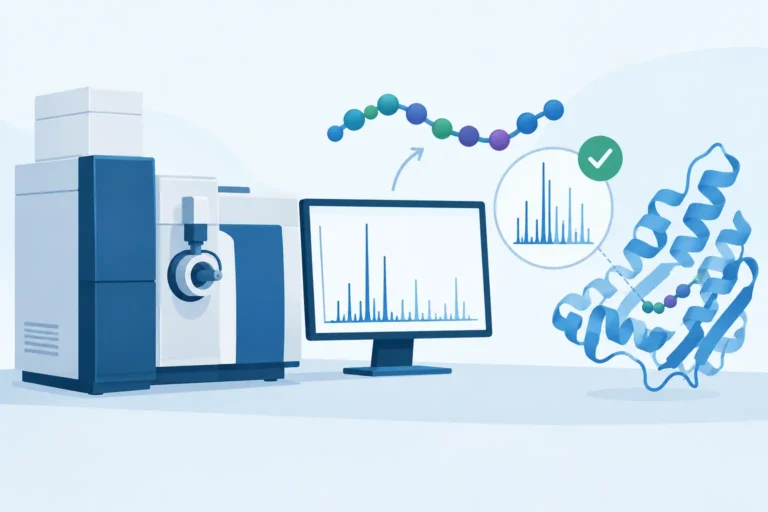
Mass spectrometry is central to peptide quality review because it helps confirm that the observed molecular mass aligns with the expected compound. This is qualitative identity evidence, not a complete guarantee of performance. Isomeric species, sequence-related impurities, salt forms, and formulation details can still require context depending on the assay.
Still, a supplier that cannot provide molecular identity confirmation leaves a fundamental question unresolved: is the material actually what it is represented to be? For controlled in-vitro research, that is not a question to defer until data become inconsistent.
Purity Screening Clarifies the Composition Profile
UHPLC analysis is commonly used to assess peptide purity and identify the relative presence of chromatographic impurities. A reported purity percentage is useful only when it is associated with a defined batch and supported by a clear analytical record. Researchers should also understand what the number represents. A high-area-percent UHPLC result speaks to chromatographic purity under the stated method; it does not automatically answer every question about residual solvents, water content, counterions, or biological activity.
That nuance does not make purity data less valuable. It makes proper interpretation more valuable. For many research applications, material screened at 99% or higher by UHPLC provides a strong starting point when paired with identity verification and lot-level documentation. The right threshold, however, depends on the method, analyte concentration, detection sensitivity, and risk tolerance of the investigation.
Endotoxin Screening Can Matter in Sensitive Systems
Endotoxin screening is especially relevant when experimental systems may respond to contamination-driven signals. Cell-based work can be vulnerable to confounding inflammatory or stress responses that have little to do with the compound under study. A documented endotoxin screen does not replace sound aseptic technique or controlled laboratory procedures, but it gives the research team another critical quality datapoint.
Researchers should verify whether endotoxin testing is performed, how results are reported, and whether the test applies to the exact batch being procured. A generic statement about quality control is weaker than a batch-specific result.
The Certificate of Analysis Should Be Usable
A Certificate of Analysis is most useful when it functions as a working document rather than a marketing attachment. Before procurement, the research team should be able to locate the product name, batch or lot identifier, test results, analytical methods, and release information that correspond to the material under review.
A credible COA creates a traceable line between the supplier’s quality system and the laboratory’s internal records. Save it with receiving documentation, inventory information, and experimental records. If an unexpected result appears months later, the ability to identify the exact batch and its reported characteristics can prevent a long and costly investigation.
For digital procurement, account-based COA access can reduce friction. It allows authorized buyers to review supporting documentation without relying on disconnected email threads or unverified files. That convenience should support traceability, not substitute for reviewing the data itself.
Build Quality Review Into Procurement
The most reliable laboratories do not treat quality review as a one-time purchasing task. They establish a repeatable qualification process that applies to each new compound, supplier, and lot. The process can be proportionate to the research stage, but it should be deliberate.
Start by matching the compound’s documented characteristics to the planned assay. Confirm the stated unit size and form, review the batch-specific COA, and determine whether the reported testing addresses the largest sources of uncertainty for the work. Next, confirm that receiving, storage, and internal labeling procedures will preserve lot traceability after delivery.
When multiple researchers or sites are involved, standardize how materials are entered into inventory. Record supplier, catalog description, batch number, receipt date, COA location, storage condition, and any internal qualification notes. This level of discipline is not administrative excess. It helps distinguish a real experimental finding from a material-control problem.
For recurring studies, lot continuity deserves attention. A supplier may offer a consistent product specification while individual batches still vary within acceptable limits. If an assay is sensitive to small compositional changes, qualify a new lot before using it in an ongoing comparison. It may be appropriate to reserve a reference lot, run bridging work, or document lot as an experimental factor. The correct approach depends on the study design and how much variance the system can tolerate.
Domestic Testing and Fulfillment Affect Research Continuity
Analytical documentation is only part of procurement quality. Research timelines are also affected by order visibility, material availability, shipment reliability, and the ability to resolve a batch question quickly. For U.S. laboratories, domestic fulfillment can simplify scheduling and reduce uncertainty around transit coordination.
Irontide Labs positions its catalog around independently tested, U.S.-based research materials with published COAs, UHPLC purity screening, mass-spectrometry identity verification, and batch-level quality controls. For qualified buyers, those controls should be assessed alongside the compound-specific documentation and the requirements of the planned investigation.
Speed matters, but it should not override verification. Expedited shipping can help protect a timeline when inventory planning falls short, yet no delivery window compensates for missing analytical evidence. The strongest procurement decision balances available documentation, appropriate specification, predictable fulfillment, and the laboratory’s own quality procedures.
A Research-First Standard for Peptide Procurement
The market uses the term “research grade” freely. Serious research requires a higher bar: material characteristics that can be reviewed, records that can be traced, and boundaries that are plainly maintained. A peptide’s name may point to a compelling line of inquiry, but the quality of the evidence behind the vial determines how confidently that inquiry can proceed.
Before the next order, ask whether the exact material can be connected to an identity result, a purity result, an endotoxin screen where relevant, and a batch-specific COA. If the answer is clear, the laboratory can focus its effort where it belongs – on controlled investigation and data worth building on.