UHPLC Purity Screening Peptides at 99%+
A clean chromatogram can protect months of controlled in-vitro work. It can also create false confidence when researchers treat one purity number as a complete quality assessment. UHPLC purity screening peptides is a critical control because it measures batch composition at high resolution, but the result carries real value only when paired with identity confirmation, documented methods, and batch-level traceability.
For research-use-only peptide procurement, 99%+ UHPLC purity is a meaningful benchmark. It is not a substitute for mass-spectrometry identity verification, endotoxin screening where relevant, or a complete Certificate of Analysis. Serious peptide research requires the full evidence chain.
What UHPLC Purity Screening Measures
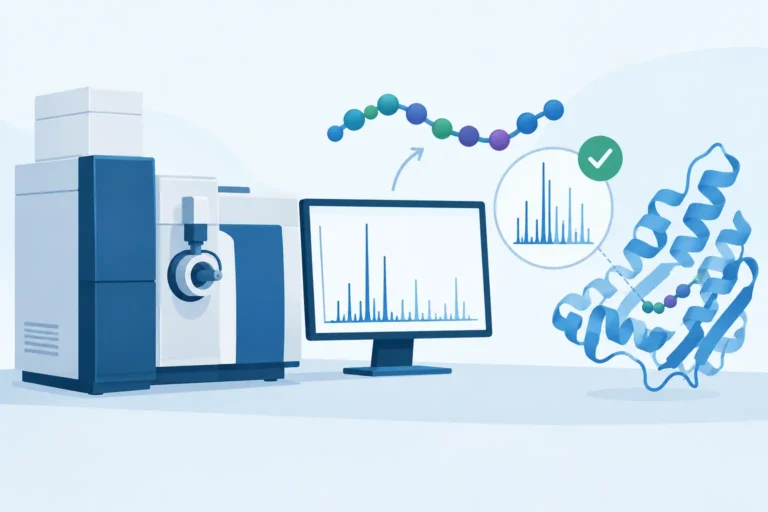
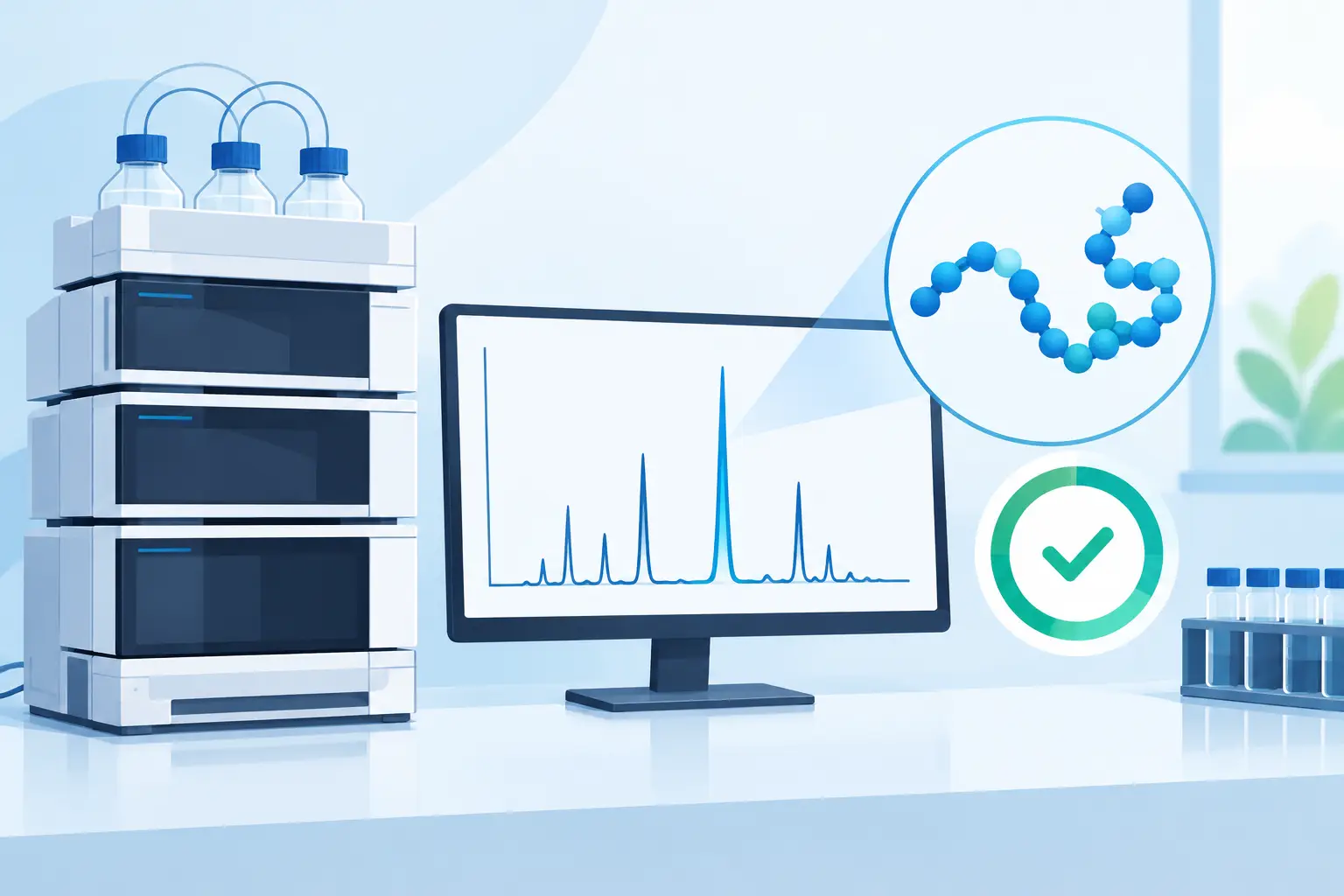
Ultra-high-performance liquid chromatography, or UHPLC, separates components in a sample before they reach a detector. In peptide analysis, the result is generally displayed as a chromatogram: signal intensity plotted against retention time. Ideally, the target peptide produces a dominant peak while related substances, deletion sequences, oxidation products, residual synthesis byproducts, and other detectable components appear as smaller peaks or remain below the method’s reporting threshold.
UHPLC operates at higher pressures and commonly uses smaller particle-size columns than conventional HPLC. Those conditions can improve separation efficiency and shorten analysis time. For peptide screening, that matters because closely related compounds may differ by only a single amino acid, a protecting-group remnant, or a modest chemical modification. A method that cannot sufficiently resolve those components may report a deceptively simple profile.
Purity is commonly expressed as area percent. The detector integrates the signal for the main peak and compares it with the total integrated signal from detected peaks. A reported result of 99% typically means the principal peak accounts for approximately 99% of the detected chromatographic area under the stated analytical conditions.
That wording matters. Area percentage is a powerful quality-control measure, but it is not automatically a universal mass balance. Different compounds can have different detector responses, and a UV method only measures substances that respond under the selected wavelength and conditions. The COA should therefore be read as method-specific analytical evidence, not as an unsupported claim of absolute chemical perfection.
Why 99%+ Matters for Peptide Research
Minor impurities can have outsized consequences in peptide characterization, stability work, receptor-binding research, and cellular pathway studies. An impurity may be chemically similar enough to co-elute poorly, yet different enough to affect experimental behavior. In other cases, a degraded or oxidized component can alter apparent stability and introduce avoidable variability between runs.
A 99%+ UHPLC result establishes a high threshold for the detectable composition of a batch. It helps researchers reduce one major source of uncertainty before materials enter an experimental workflow. This is particularly relevant when comparing conditions, generating repeatable datasets, or working with limited assay capacity where failed runs consume valuable time and resources.
The practical advantage is consistency. Researchers need to know that a material procured today is supported by the same disciplined quality expectations as material procured later. Batch-level UHPLC screening helps establish that expectation when the result is documented, attributable to a specific lot, and available for review through a Certificate of Analysis.
Still, the right purity requirement depends on the work. Early-stage feasibility screening may have different tolerance limits than quantitative peptide characterization or tightly controlled comparative studies. The key is not pursuing a purity figure in isolation. It is selecting material with quality documentation that matches the sensitivity, purpose, and risk profile of the experiment.
A Purity Result Needs Identity Confirmation
A dominant UHPLC peak does not, by itself, prove that the peak belongs to the intended peptide. It confirms that one detectable component dominates the chromatographic profile. Identity confirmation requires another analytical dimension.
Mass spectrometry provides that dimension by assessing the molecular mass associated with the sample. When UHPLC purity screening is paired with mass-spectrometry identity verification, researchers gain stronger evidence that the material is both compositionally clean and consistent with the intended molecular target.
The distinction is operationally significant. A sample could be highly pure in the sense that it contains one predominant compound, while still being the wrong compound because of labeling, handling, or production error. Conversely, an identity-consistent sample may still contain detectable impurities that can complicate sensitive work. Neither test replaces the other.
For that reason, a credible research-use-only quality program should treat UHPLC and mass spectrometry as complementary controls. UHPLC supports quantitative composition assessment. Mass spectrometry supports molecular identity confirmation. Together, they provide a far more defensible basis for procurement and experimental planning.
How to Read a Peptide UHPLC COA
A Certificate of Analysis should make the reported purity result traceable to the material in hand. At minimum, researchers should be able to connect the product name, lot or batch identifier, reported purity, and test status without ambiguity. A document that cannot be tied to a specific batch has limited value when consistency matters.
Method context also deserves attention. The chromatographic conditions, detector approach, and reported result should be sufficiently clear to establish what was measured. Depending on the testing format, useful supporting details can include the column chemistry, mobile-phase system, detection wavelength, retention time, chromatogram, sample concentration, and date of analysis.
The chromatogram itself can be informative, but it should not be overinterpreted. A sharp major peak is encouraging, yet peak shape alone does not establish purity. Review the integration, any visible secondary peaks, and the stated purity result. Ask whether the documentation is current for the batch being procured rather than a generic example from another lot.
For compounds used in sensitive cellular or biochemical workflows, endotoxin screening may be another relevant control. UHPLC does not detect endotoxin, and mass spectrometry is not a substitute for an endotoxin assay. Each quality test addresses a different source of experimental risk.
Common Limits of UHPLC Purity Screening
UHPLC is highly effective, but no analytical technique answers every question. Understanding its limits prevents a single number from being asked to carry more meaning than the method supports.
A UV-based purity method may not detect every non-UV-active impurity with equal sensitivity. Co-elution can obscure components if the method lacks sufficient resolving power. Sample preparation, storage, and solvent conditions can also influence observed results. Peptides may undergo oxidation, deamidation, aggregation, or other changes over time, so an original release result does not eliminate the need for appropriate receiving, storage, and handling procedures.
There is also a difference between analytical purity and suitability for a specific workflow. A peptide can meet a 99%+ UHPLC target and still require researchers to evaluate concentration, reconstitution behavior, stability under their conditions, and compatibility with their assay system. Quality documentation reduces uncertainty. It does not replace sound experimental design.
Building a Defensible Procurement Standard
For qualified researchers and procurement teams, the practical standard is straightforward: seek a documented, batch-specific quality package rather than relying on a label claim. High UHPLC purity should be accompanied by identity verification and COA access. When the intended workflow calls for it, endotoxin screening and additional concentration or characterization data should also be considered.
Irontide Labs positions its research-use-only peptide materials around this evidence-first model, with independently tested U.S. batches, published COA access, UHPLC purity screening at 99% or higher, and mass-spectrometry identity confirmation. These controls are designed for controlled in-vitro laboratory investigation only, not human, veterinary, clinical, diagnostic, therapeutic, or pharmaceutical use.
Before introducing a peptide into a study, match the batch documentation to the demands of the work. Confirm the lot, review the stated test results, preserve the COA with study records, and maintain handling controls after receipt. The most useful purity number is not simply the highest one on a product page. It is the one backed by transparent analytical evidence and applied within a disciplined research process.