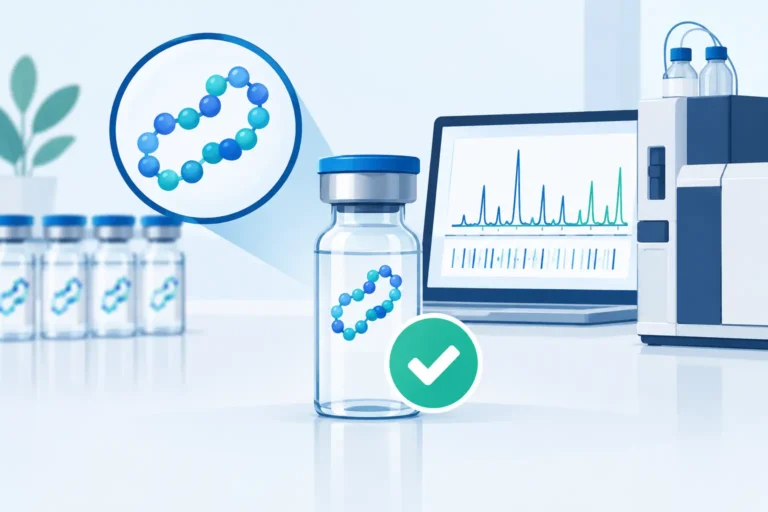
COA Testing Versus Supplier Claims That Prove Quality
A peptide supplier can state “99% purity,” “research grade,” or “independently tested” on every product page. Those statements may describe a legitimate quality program, but they do not independently establish the quality of the specific material arriving at your laboratory. COA testing versus supplier claims is not a branding debate. It is a procurement control that affects experimental consistency, traceability, and the interpretability of downstream results.
For controlled in-vitro work, the question is not whether a supplier makes attractive quality claims. The question is whether those claims are supported by batch-specific analytical evidence that can be reviewed before the material enters a research workflow.
COA testing versus supplier claims starts with evidence
A supplier claim is an assertion about a product or process. It may identify a target purity threshold, describe analytical capabilities, or state that a compound has been screened by a third-party laboratory. These claims can help researchers understand how a supplier positions its materials, but they are not a substitute for the underlying record.
A Certificate of Analysis, or COA, is the record that should connect those statements to a defined lot or batch. A meaningful COA identifies the material tested, the relevant batch or lot number, the analytical method, the reported result, and the laboratory or responsible testing entity. When the COA corresponds directly to the unit being procured, it gives a research team an auditable basis for evaluating material quality.
The distinction matters because a broad statement such as “tested at 99%+” can refer to a historical result, a representative lot, an internal target, or a result generated under an unspecified method. A batch-level COA narrows the question: What did this material demonstrate under this test method?
That does not mean every COA is equally informative. A document without a batch identifier, method reference, date, analyte identification, or measurable results may offer limited value. Documentation is strongest when it allows the buyer to match the data to the exact research material and understand what was actually evaluated.
What a useful COA should verify
For research-use-only peptide procurement, purity alone is not the complete quality picture. A well-characterized material requires evidence that the expected compound is present and that the reported purity result is meaningful in context.
Purity by UHPLC
Ultra-high-performance liquid chromatography, or UHPLC, is commonly used to assess chromatographic purity. The resulting percentage can provide a clear quantitative benchmark for the primary peak relative to detectable impurities under the specified analytical conditions.
A reported purity value of 99% or higher can be a strong quality indicator, but researchers should understand what it does and does not answer. UHPLC helps characterize the relative composition of the sample. It does not, by itself, conclusively establish molecular identity. A high-purity chromatogram is valuable only when the dominant peak has also been linked to the intended analyte.
Review the stated method, reported purity, and batch association. If a supplier publishes only a generic purity threshold without supporting chromatographic data or a batch-specific result, the claim remains less actionable for qualification purposes.
Identity confirmation by mass spectrometry
Mass spectrometry addresses a separate analytical question: does the observed molecular mass align with the expected peptide or compound? For peptide research materials, identity confirmation is a critical complement to chromatographic purity analysis.
A sample can present a clean chromatographic profile while still requiring identity confirmation. Conversely, an expected molecular mass does not quantify the full impurity profile. UHPLC and mass spectrometry are more useful together because they evaluate different aspects of the material. One supports purity characterization; the other supports identity verification.
When a COA or associated analytical record shows mass-spectrometry confirmation, researchers can better assess whether the tested material aligns with the stated molecular target. This is especially relevant when experiments depend on defined sequence, molecular weight, or compound-specific activity in non-clinical assay systems.
Endotoxin screening where research conditions require it
Endotoxin is not a purity percentage, and it should not be treated as one. It is a separate contamination consideration that may be relevant to cell-based or other sensitive in-vitro workflows. Whether endotoxin screening is necessary depends on the experimental design, the assay system, and the laboratory’s internal acceptance criteria.
A supplier claim that a material is “clean” does not tell a researcher whether endotoxin was assessed, by which method, or against what reporting limit. A documented endotoxin result provides a more concrete basis for risk assessment. It also helps laboratories distinguish chemical purity from biological contamination control.
For serious research procurement, the strongest documentation separates these attributes rather than collapsing them into a single quality label.
Why supplier claims still have value
Supplier claims are not inherently unreliable. They often communicate the framework behind a quality program: domestic testing, third-party analysis, lot controls, storage practices, fulfillment standards, and access to documentation. They can help researchers narrow a field of potential suppliers before conducting a deeper review.
The problem arises when claims become the final qualification step. A phrase such as “lab tested” is incomplete unless the buyer can determine what was tested, when it was tested, and whether the record applies to the batch being purchased.
A credible supplier should be able to make its quality position legible through evidence. This does not require every buyer to recreate the testing process or interpret raw instrumentation data without context. It does require enough transparency to verify the material, assess the relevant specifications, and maintain internal procurement records.
At Irontide Labs, the quality position is built around independent U.S. laboratory testing, batch-level COAs, UHPLC purity screening, mass-spectrometry identity verification, and endotoxin screening. The objective is not to replace a laboratory’s own qualification procedures. It is to provide documented evidence that supports them.
The risks of relying on unsupported claims
Unsupported or poorly documented claims create avoidable uncertainty. If the delivered material cannot be tied to a defined analytical record, a laboratory may have difficulty investigating unexpected assay behavior, comparing results across experiments, or qualifying a replacement batch.
This uncertainty can appear in several forms. A generic COA may describe a different lot than the material received. A purity percentage may lack a stated method. An identity claim may be asserted without mass-spectrometry confirmation. A document may show a pass/fail statement while omitting the underlying result and specification.
None of these issues automatically proves that material is unsuitable. They do, however, reduce the researcher’s ability to make an evidence-based decision. For a procurement team managing repeat orders, collaborative studies, or sensitive assay conditions, that missing traceability can become a significant operational cost.
The practical trade-off is clear. Lower-friction sourcing may appear efficient at the point of purchase, but inadequate documentation can introduce delays when results need to be explained, repeated, or defended internally.
A practical review process before procurement
The most effective approach is to establish document review before ordering rather than after a result raises questions. Begin by confirming that the supplier identifies the compound, concentration or unit size, and intended research-use-only status clearly. Then evaluate whether a COA is available for the relevant batch or can be accessed through an account or order record.
Next, compare the document against the laboratory’s acceptance criteria. For many peptide research workflows, that review includes the reported UHPLC purity result, mass-spectrometry identity confirmation, batch number, analysis date, and any endotoxin information relevant to the assay. The appropriate requirements depend on the work being conducted. A stability study, a peptide characterization project, and a sensitive cell-based investigation may not require the same documentation set.
Finally, retain the COA with the purchase record and internal sample documentation. If a new lot is introduced, review that lot rather than assuming that a prior result applies. Batch-to-batch verification is not administrative overhead. It is a control that protects comparability across research activities.
Documentation supports better research decisions
The strongest procurement standard is not blind trust and not unnecessary skepticism. It is traceable evidence matched to the material under review. Supplier claims can communicate intent and capability, but COA testing provides the data needed to evaluate a specific batch with greater confidence.
For research-use-only compounds, that distinction protects the integrity of non-clinical work while maintaining clear compliance boundaries. Materials should be evaluated and used only for controlled laboratory research, never for human, veterinary, clinical, diagnostic, therapeutic, or pharmaceutical applications.
When the next order is evaluated, treat the COA as more than a downloadable document. Treat it as part of the experimental record – a direct connection between procurement discipline and the quality of the questions your research can answer.