What Is GHK-Cu? 3 Essential Roles in Cellular Research
Among the thousands of signaling molecules studied in modern biochemistry, few have a research track record as deep as GHK-Cu (CAS 49557-75-7). First isolated from human plasma in 1973, this naturally occurring copper-binding tripeptide has spent over five decades at the center of tissue remodeling and cellular aging studies.
For laboratories designing dermal, extracellular matrix, or genetic expression assays, answering the core question—what is GHK-Cu—starts with how a simple three-amino-acid sequence coordinates copper ions to signal cellular repair.
What Is GHK-Cu?
GHK-Cu is a naturally occurring coordination complex made of the tripeptide glycyl-L-histidyl-L-lysine (Gly-His-Lys) bound to a copper(II) ion (Cu²⁺). Because the GHK sequence has an exceptionally high affinity for copper, it acts as a biological shuttle that safely transports copper into cells where it is needed for enzymatic reactions.
In biological systems, GHK is found naturally in plasma, saliva, and urine, and it is also embedded within the alpha 2(I) chain of type I collagen. When tissue damage occurs, proteolytic enzymes cleave the collagen and release GHK directly into the site of injury as an early biochemical repair signal. Notably, endogenous plasma levels of GHK decline sharply with age—dropping from roughly 200 ng/mL at age 20 down to about 80 ng/mL by age 60.
How GHK-Cu Functions at the Cellular Level
In controlled in-vitro and preclinical models, GHK-Cu does not rely on a single isolated pathway. Instead, it acts as a broad biological modulator that helps cells coordinate structural maintenance and stress responses.
To understand what is GHK-Cu doing in laboratory studies, researchers focus on three primary mechanisms:
- Extracellular Matrix and Collagen Remodeling: GHK strongly influences dermal fibroblasts—the cells responsible for building structural tissue scaffolding. In cell cultures, it stimulates the synthesis of collagen, elastin, and glycosaminoglycans. Just as importantly, it modulates metalloproteinases (enzymes that break down damaged proteins) and their inhibitors, promoting balanced tissue turnover rather than unchecked degradation.
- Broad Gene Expression Modulation: Research utilizing the Broad Institute’s Connectivity Map revealed that GHK can upregulate or downregulate over 31% of human genes by 50% or more—impacting roughly 4,000 genes in total. Many of these stimulated pathways are directly tied to tissue remodeling, antioxidant defense, and cellular longevity.
- DNA Repair and Cellular Viability: In-vitro studies on cultured human fibroblasts exposed to radiation demonstrated that GHK-Cu can help restore cellular viability and stimulate the expression of key DNA repair genes. It also supports keratinocyte proliferation and increases markers of cellular stemness, such as integrins and p63 expression.
Why GHK-Cu Remains a Benchmark in Longevity Research
A major reason investigators continue studying what is GHK-Cu and its downstream effects is its unique ability to shift aged cellular models toward a more youthful protein-synthesis profile. In the landmark 1973 experiment that led to its discovery, adding young human plasma containing GHK to older liver tissue caused the aged cells to begin producing proteins characteristic of younger tissue.
Because it is a small, endogenous molecule with a well-documented profile in laboratory models, GHK-Cu serves as a reliable reference compound for studying wound-healing kinetics, angiogenesis, and oxidative stress signaling.
Chemical Profile and Laboratory Handling
When preparing GHK for analytical assays, verifying the exact chemical profile is essential. One unmistakable physical trait, is its distinctive blue or blue-violet color in lyophilized powder form. This hue comes directly from the chelated copper(II) ion; a plain white powder indicates uncomplexed GHK lacking copper.
| Property | Specification |
| Compound | GHK-Cu (Copper Tripeptide-1) |
| CAS Number | 49557-75-7 (Complex) / 89030-95-5 |
| Amino Acid Sequence | Gly-His-Lys·Cu |
| Molecular Formula | C14H22CuN6O4 |
| Molecular Weight | ~403.93 g/mol |
| Appearance | Blue to blue-violet lyophilized powder |
| Storage (Lyophilized) | -20°C, sealed, protected from light |
For optimal stability, sealed lyophilized vials should be stored frozen at -20°C away from light and moisture. Once reconstituted in a sterile solvent for in-vitro testing, stock solutions should be refrigerated and handled under pH-controlled conditions to prevent peptide hydrolysis.
Sourcing High-Purity GHK-Cu for In-Vitro Assays
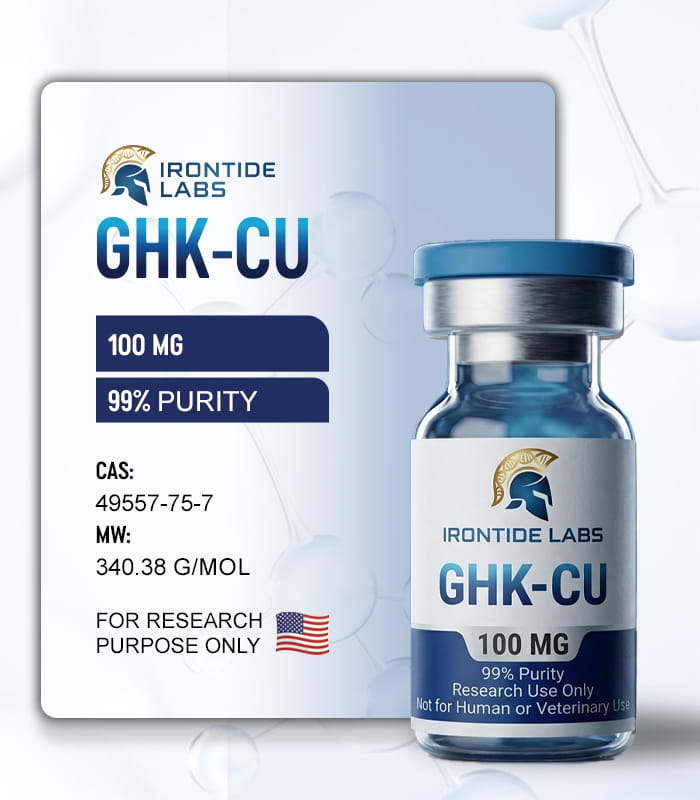
In gene-expression and fibroblast assays, inconsistent copper chelation or synthesis impurities can skew experimental readouts. Investigators sourcing lyophilized [Link: GHK-Cu] for laboratory research should always verify batch quality before starting an assay. Every vial should be accompanied by an independent, third-party Certificate of Analysis (COA) confirming identity and ≥99% purity via HPLC and Mass Spectrometry.
Compliance and Research Boundaries
Irontide Labs supplies GHK-Cu exclusively for in-vitro laboratory research and analytical modeling. All compounds in the Irontide catalog are sold strictly for Research Use Only (RUO). They are not compounded, packaged, or intended for human, veterinary, diagnostic, or therapeutic use.