Why Independently Tested Research Compounds Matter
A research result is only as defensible as the material introduced into the experiment. When a peptide or related compound arrives without clear identity data, purity evidence, or lot-specific documentation, uncertainty enters before the first plate is prepared. Independently tested research compounds are designed to reduce that uncertainty by giving qualified researchers objective evidence of what a batch contains and how it was evaluated.
For controlled in-vitro work, this is not a marketing distinction. A material that is mislabeled, degraded, contaminated, or inconsistently concentrated can distort assay behavior, confound comparisons, and consume time that no statistical correction can recover. Independent verification gives procurement teams and laboratory operators a more reliable basis for selecting research-use-only materials.
What Independent Testing Actually Establishes
Independent testing means a batch is assessed by a laboratory separate from the supplier’s internal handling or production process. The value is not simply that a document exists. The value is that the document should connect a specific lot to defined analytical methods, measurable results, and an identifiable quality standard.
For peptide research materials, the most useful testing package typically addresses several different questions. Is the expected compound present? Does the sample reach the stated purity threshold? Is the measured mass consistent with the intended molecular identity? Are impurities, concentration concerns, or endotoxin risks being evaluated within the supplier’s stated scope?
No single test answers every question. A high purity percentage alone does not establish molecular identity. Likewise, a mass result consistent with the target does not, by itself, describe chromatographic purity. Serious quality control uses complementary methods because each method closes a different gap in the evidence chain.
UHPLC Purity Screening
Ultra-high-performance liquid chromatography, or UHPLC, separates components within a sample and measures their relative chromatographic presence. For procurement purposes, this is often the primary evidence used to assess purity. A reported result of 99% or higher indicates that the target peak represents the stated proportion of the analyzed sample under the reported method.
That number deserves context. Purity is method-dependent, and a credible Certificate of Analysis should make clear which lot was tested and what result was obtained. Researchers should avoid treating a generic purity claim as interchangeable with a batch-level result. The lot being purchased is the lot that matters.
Mass Spectrometry Identity Verification
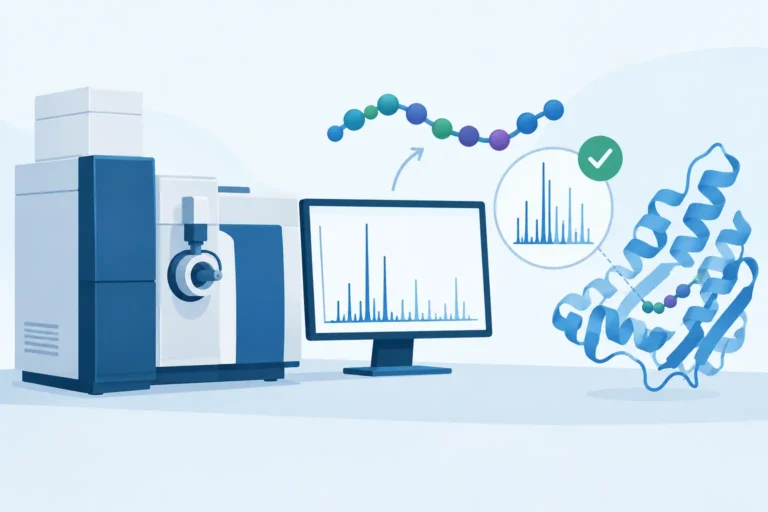
Mass spectrometry provides a complementary identity check by measuring molecular mass characteristics. In peptide work, this analysis helps confirm whether the observed material aligns with the expected compound rather than merely producing a favorable chromatography profile.
Identity confirmation is particularly valuable where compounds have similar handling characteristics or where small variations could alter experimental interpretation. It does not eliminate the need for method-appropriate laboratory controls, but it strengthens the starting material record before a study begins.
Endotoxin Screening and Its Proper Place
Endotoxin screening addresses a different quality consideration. Depending on the planned in-vitro system, endotoxin can introduce unwanted biological activity or interfere with readouts. Screening helps researchers understand whether a batch has been evaluated for this potential source of experimental noise.
The appropriate specification depends on the research model, assay sensitivity, and internal protocol. A published endotoxin result should be considered alongside the full analytical record, not used as a stand-alone determination of suitability. Research-use-only materials require researchers to define fitness for their own controlled application.
Why Documentation Changes Procurement Decisions
A Certificate of Analysis is not paperwork added after the fact. It is the traceable record that allows a laboratory to connect the vial on the bench to a documented quality review. Without that connection, it becomes harder to investigate a failed replication, compare results across lots, or explain material selection during an internal audit.
The strongest COA practices are batch-specific, readable, and accessible before or at the point of procurement. They should identify the compound, lot or batch number, applicable test results, and analytical methods or testing categories. Documentation that is difficult to locate, tied to an unrelated lot, or limited to broad claims creates avoidable ambiguity.
For organizations managing multiple studies, batch traceability also supports operational discipline. A procurement record can be aligned with receiving logs, sample labeling, storage conditions, and experiment documentation. When results shift unexpectedly, that chain of information helps distinguish a material question from a protocol, instrument, or biological-model question.
Independently Tested Research Compounds and Reproducibility
Reproducibility begins well before data collection. Researchers can standardize incubation time, plate layout, solvent selection, and instrument settings, yet still face variability if the input compound is not consistently characterized. The goal is not to assume that independent testing guarantees a specific experimental outcome. It does not. The goal is to narrow a meaningful source of uncertainty.
This distinction matters in studies involving peptide characterization, cellular research, metabolic pathway investigation, and stability assessment. These workflows may be sensitive to purity profiles, identity deviations, handling history, or contamination. Batch-level analysis gives the research team a defined baseline from which to build its own qualification process.
There is also a practical trade-off. Materials supported by independent analytical work and transparent documentation may not compete solely on the lowest advertised price. However, a lower acquisition cost can become expensive when a questionable batch delays a project, compromises comparability, or requires a complete repeat of a controlled run. For serious research procurement, total experimental risk is often a more useful measure than vial price alone.
How to Evaluate a Supplier’s Quality Claims
Researchers should evaluate claims with the same discipline they apply to experimental inputs. The phrase “tested” is broad. Ask what was tested, by whom, by which method, and whether the result belongs to the available lot.
Start by reviewing whether the supplier provides a batch-level COA rather than a general specification sheet. Then look for analytical evidence that separates purity from identity confirmation. UHPLC and mass spectrometry serve different purposes, and both are meaningful when clearly reported. If endotoxin screening is relevant to the intended in-vitro workflow, verify that the supplier identifies the screening status and result rather than making a vague cleanliness claim.
The procurement experience also matters. A reliable supplier should make lot documentation obtainable, clearly identify unit sizes, and maintain a process that supports order tracking and accountable fulfillment. Domestic testing and fulfillment can simplify communication and reduce avoidable handoffs, although researchers should still verify the documentation for the specific batch they receive.
At Irontide Labs, this quality position centers on independently tested, research-use-only compounds supported by UHPLC purity screening, mass-spectrometry identity verification, endotoxin screening, and batch-level COA access. These controls are intended for qualified researchers conducting controlled non-clinical investigation, not for human, veterinary, diagnostic, therapeutic, or pharmaceutical use.
Build Material Qualification Into the Workflow
External documentation is the first layer of material qualification, not the last. Once a compound is received, laboratory procedures should preserve the connection between the COA and the working material. Record the lot number at receipt, confirm the label against the order record, follow established storage requirements, and document reconstitution or preparation conditions according to the research protocol.
If a study spans multiple lots, decide in advance how lot transitions will be managed. Some programs may qualify a new lot before introducing it into an ongoing experiment. Others may reserve one lot for a complete study phase to reduce variables. The right approach depends on the assay, the available quantity, the criticality of continuity, and the laboratory’s internal quality system.
Researchers should also resist overinterpreting a COA. A 99% or higher UHPLC result and confirmed mass identity provide meaningful evidence about the supplied material, but they do not replace stability studies after preparation, matrix compatibility testing, or assay-specific controls. Transparent supplier testing and disciplined in-house methods work together. Neither substitutes for the other.
Choose Evidence Over Assumption
The most useful research materials do more than arrive on time. They arrive with evidence that can be reviewed, recorded, and defended. When identity, purity, endotoxin screening, and batch traceability are visible, researchers can spend less time questioning the starting material and more time refining the question the experiment is meant to answer.
For any new procurement decision, begin with the batch documentation. A clear COA and complementary analytical data will not answer every experimental question, but they establish the standard a serious research workflow should demand.