What Does NAD+ Do? 3 Essential Roles in Cellular Research.
If you spend any time reading modern biochemistry or cellular aging literature, one molecule shows up almost everywhere: Nicotinamide Adenine Dinucleotide, better known as NAD+ (CAS 53-84-9). While it has been on the scientific radar for over a century, laboratory interest in this coenzyme has exploded over the last decade.
For researchers designing metabolic or longevity assays, answering the core question—what does NAD+ do—comes down to understanding how cells generate energy and repair themselves under stress.
What Exactly Is NAD+?
Unlike peptides, which are chains of amino acids, NAD+ is a dinucleotide coenzyme found in every living cell. It consists of two nucleotides joined through their phosphate groups: one containing an adenine nucleobase and the other containing nicotinamide.
In a laboratory setting, scientists generally track this molecule in two distinct states: NAD+ (the oxidized form) and NADH (the reduced form). The ratio between these two forms acts as a real-time indicator of a cell’s metabolic health. When researchers talk about cellular energy efficiency, they are usually looking closely at how effectively a cell cycles between NAD+ and NADH.
What Does NAD+ Do at the Cellular Level?
When introduced to controlled in-vitro environments, NAD+ does far more than just sit in the background. It acts as both a tireless electron shuttle and a fuel source for critical regulatory enzymes.
To break down exactly what does NAD+ do in cellular models, researchers focus on three primary mechanisms:
- Mitochondrial Energy and ATP Synthesis: At its most basic level, NAD+ is an oxidizing agent. It accepts electrons from metabolic reactions—like glycolysis and the citric acid cycle—converting into NADH. Those electrons are then handed off to the mitochondrial electron transport chain to drive the production of adenosine triphosphate (ATP), the primary energy currency of the cell. Without adequate NAD+, cellular respiration stalls.
- Sirtuin Activation: Beyond energy production, NAD+ is a required substrate for a family of seven proteins called sirtuins (SIRT1 through SIRT7). Sirtuins regulate gene expression, cellular stress responses, and protein deacetylation. Because sirtuins literally consume NAD+ to function, their activity in an assay is directly tied to how much bioavailable NAD+ is present.
- PARP-Mediated DNA Maintenance: Cells constantly face oxidative stress that can damage DNA strands. When breaks occur, enzymes known as poly(ADP-ribose) polymerases (PARPs) rush to the site to signal and coordinate repairs. Just like sirtuins, PARPs burn through intracellular NAD+ reserves to get the job done.
Why NAD+ Depletion Drives Modern Research
A major reason laboratories keep asking what does NAD+ do is because its levels naturally drop in aging cellular models. As cells age or experience chronic inflammation, NAD+-consuming enzymes—particularly CD38 and overactive PARPs—begin to outpace the cell’s ability to recycle or synthesize new coenzyme.
In preclinical and in-vitro studies, this drop in NAD+ is closely linked to mitochondrial dysfunction and disrupted communication between the mitochondria and the cell nucleus. By studying how cells respond to NAD+ repletion or precursor pathways, investigators can isolate how energy deficits impact cellular senescence, oxidative stress, and metabolic signaling.
Chemical Profile and Laboratory Handling
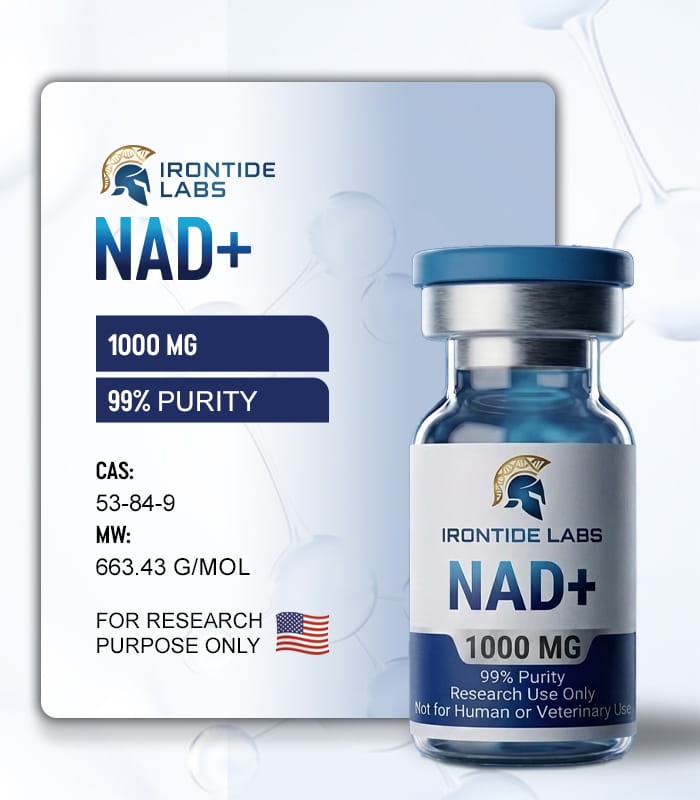
When working with lyophilized NAD+ in an analytical setting, precision matters. The compound carries a CAS Number of 53-84-9, a molecular formula of C21H27N7O14P2, and a molecular weight of 663.43 g/mol.
Because NAD+ is a relatively sensitive molecule, proper storage is non-negotiable for reproducible data. Lyophilized powder is hygroscopic (it absorbs moisture from the air) and degrades faster when exposed to heat, UV light, or alkaline conditions.
For long-term stability, sealed vials should be stored frozen at -20°C away from direct light. Once reconstituted in a sterile, pH-balanced solvent for an assay, stock solutions should be kept refrigerated and used within a tight timeframe to prevent hydrolysis.
Sourcing High-Purity NAD+ for In-Vitro Assays
In delicate enzymatic and mitochondrial assays, purity dictates accuracy. Trace contaminants or degraded byproducts can skew redox ratios and compromise sirtuin or PARP readouts.
Investigators sourcing lyophilized NAD+ for laboratory modeling should always verify batch integrity before starting an experiment. Every vial should be backed by an independent, third-party Certificate of Analysis (COA) confirming identity and purity via HPLC and Mass Spectrometry.
Compliance and Research Boundaries
Irontide Labs supplies NAD+ exclusively for in-vitro laboratory research and analytical modeling. All compounds in the Irontide catalog are sold strictly for Research Use Only (RUO). They are not compounded, packaged, or intended for human, veterinary, diagnostic, or therapeutic use.