
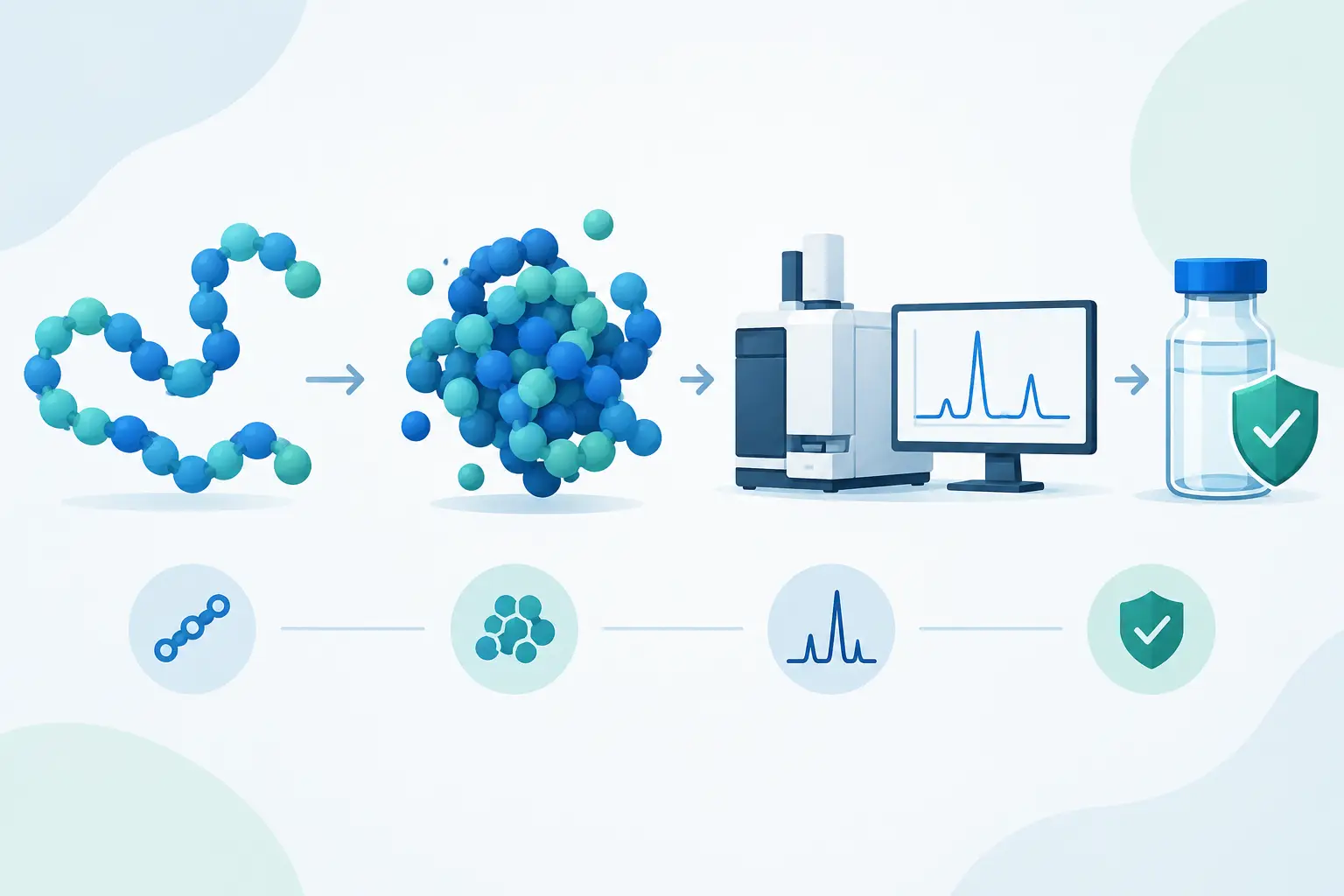
Peptide Aggregation: Causes, Detection, Control
A peptide can meet its stated purity specification and still introduce avoidable variability after it reaches the laboratory. Peptide aggregation is one of the most common reasons: molecules that were initially well-characterized can self-associate during reconstitution, dilution, storage, or assay preparation. The result may be lower effective concentration, altered solution behavior, inconsistent replicate data, or misleading signals that appear to be biological effects.
For controlled in-vitro work, aggregation should be treated as a material-state question, not a minor handling detail. Researchers need to understand what promotes it, how to recognize it, and which controls can distinguish a genuine experimental observation from an artifact of sample preparation. For qualified researchers seeking batch-verified materials with complete analytical documentation, you can browse Irontide’s research compounds directly in our catalog.
What peptide aggregation actually means
Peptide aggregation occurs when individual peptide molecules associate into dimers, oligomers, larger soluble assemblies, or insoluble particulates. These species can form through noncovalent interactions such as hydrophobic association, hydrogen bonding, electrostatic attraction, and aromatic stacking. In some cases, covalent changes including oxidation or disulfide exchange can also contribute to altered molecular populations.
Aggregation is not a single event with a single visual signature. A visibly cloudy sample may indicate substantial particulate formation, but a clear solution can still contain soluble aggregates. Conversely, a peptide that appears poorly soluble may be experiencing incomplete dissolution rather than true self-association. Those distinctions matter because each condition requires a different analytical and handling response.
The aggregation risk is encoded partly in peptide sequence and structure. Hydrophobic residues, extended beta-sheet-forming regions, amphipathic character, charge distribution, molecular concentration, and terminal modifications can all influence association behavior. A protocol that performs predictably for one compound should not be assumed to transfer unchanged to another.
Why aggregation compromises in-vitro research
The most immediate consequence is uncertainty around the concentration actually available in solution. If a fraction of material is aggregated, the nominal concentration calculated from mass and volume may not represent the monomeric or otherwise relevant species present during an experiment. This can flatten or shift concentration-response relationships and complicate comparisons between runs.
Aggregates can also create assay-specific interference. Larger assemblies may scatter light, affect absorbance-based readouts, adsorb to plastics or membranes differently than monomeric material, or interact nonspecifically with assay components. In cell-free systems, they may alter signal baselines. In broader in-vitro workflows, they can introduce variable exposure conditions that are difficult to identify after the fact.
Lot-to-lot consistency cannot eliminate all aggregation risk, because handling conditions occur after procurement. It can, however, reduce uncertainty at the starting point. Documented identity confirmation, purity screening, and batch-specific Certificates of Analysis establish a defensible baseline for incoming research material. They do not replace formulation and stability assessment in the receiving laboratory, but they help separate material-quality questions from downstream handling variables.
Conditions that increase aggregation risk
Concentration and solvent composition
Higher concentration usually increases molecular collision frequency and can push a peptide past its practical solubility limit. The threshold is compound-specific and may change substantially between a concentrated stock and a final working dilution. Rapidly forcing a difficult peptide into solution can produce a preparation that looks acceptable initially but changes over time.
Solvent composition matters just as much. A change in organic cosolvent percentage, ionic strength, pH, or buffer identity can alter charge state and expose hydrophobic interactions. A solvent system suitable for initial dissolution may not remain suitable after dilution into the final experimental matrix. Researchers should evaluate the full path from stock preparation through assay conditions, not only the first reconstitution step.
pH, salts, and temperature
Peptides are often most vulnerable near conditions where net charge is reduced, because electrostatic repulsion between molecules decreases. Buffer selection and pH can therefore have a major effect on solution behavior. Salts may stabilize some preparations while promoting association in others by screening charge interactions or changing hydration behavior.
Temperature introduces another trade-off. Elevated temperature can accelerate dissolution in some cases, yet it can also accelerate chemical degradation and aggregation pathways. Repeated freeze-thaw cycles add stress through local concentration changes during freezing, phase separation, and prolonged handling at nonstorage temperatures. Aliquoted stocks are often more controllable than repeatedly accessing a single large preparation.
Interfaces and mechanical stress
Aggregation may begin at interfaces rather than in the bulk solution. Air-liquid surfaces, vial walls, pipette tips, filters, and certain plastics can promote adsorption and local concentration effects. Vigorous vortexing, foaming, or unnecessary agitation can expand those interfaces and increase stress on susceptible compounds.
This does not mean all mixing is harmful. Complete, reproducible dissolution is necessary. The goal is controlled mixing, minimal foam, compatible labware, and a documented sequence that can be repeated by another operator.
How to detect peptide aggregation
No single test answers every aggregation question. The correct approach depends on the compound, the concentration range, the available instrumentation, and whether the concern is visible particulate matter, soluble oligomers, chemical change, or loss of assay performance.
Visual inspection is a useful first screen. Record clarity, color, visible particles, and time-dependent changes after reconstitution and dilution. It is fast, but it cannot confirm the absence of small or soluble aggregates.
Analytical techniques provide greater resolution. Size-exclusion chromatography can help separate molecular populations by apparent size. Dynamic light scattering can indicate particle-size distributions, although interpretation can be disproportionately influenced by a small number of large particles. Analytical ultracentrifugation, microscopy, turbidity measurements, and light-obscuration methods may be appropriate when particulate characterization is central to the study.
UHPLC and mass spectrometry serve a different but complementary role. They are central tools for evaluating purity, identity, and certain chemical alterations. They may reveal degradation products or modifications associated with changing sample behavior, but they should not be treated as universal standalone aggregation assays. A rigorous method package aligns the technique with the question being asked.
For routine work, trend data can be as valuable as a single measurement. Compare a freshly prepared control with material held under defined conditions. Track signal stability, recovery after dilution, visible appearance, and analytical profiles across time points. That design turns aggregation from a suspected explanation into a testable variable.
A controlled workflow for reducing aggregation artifacts
Begin with traceable incoming material. Verify the lot, unit size, storage requirements, and available documentation before preparation. At Irontide Labs, batch-level COA access, UHPLC purity screening, mass-spectrometry identity verification, and endotoxin screening support a documented starting point for research-use-only procurement.
Next, define a reconstitution procedure before opening the vial. Record the solvent, target stock concentration, pH where applicable, mixing method, container type, aliquot plan, storage temperature, and allowable hold time. If the peptide is new to the workflow, use a small compatibility study rather than committing all material to a single unvalidated condition.
Prepare stocks at concentrations that are practical for downstream dilution but do not unnecessarily concentrate the compound. Allow sufficient time for dissolution, using gentle and consistent mixing. If filtration is considered, assess adsorption and recovery first, since a filter can remove aggregates while also reducing the amount of peptide recovered.
After preparation, minimize avoidable stress. Use aliquots to limit freeze-thaw exposure, avoid extended bench holds, and standardize the transition from storage to working solution. When diluted samples are used over several hours or days, evaluate stability in the actual assay matrix rather than relying only on stock-solution behavior.
Finally, build decision criteria into the protocol. Define what constitutes an acceptable appearance, recovery range, particle profile, chromatographic result, or performance control before analyzing the main dataset. A pre-established criterion is more defensible than deciding whether a sample was acceptable after the results are known.
Treat aggregation as an experimental variable
Not every association event is a failure. In some peptide investigations, self-assembly is the phenomenon under study. The critical requirement is intent and characterization. If aggregation is expected or desired, it should be measured, controlled, and reported as part of the experimental condition. If it is unwanted, it should be challenged with an equally deliberate control strategy.
The strongest peptide workflows do not assume that a labeled concentration tells the whole story. They verify the material, document preparation, monitor solution state, and preserve the evidence needed to interpret unexpected findings. That discipline keeps a solvable handling variable from becoming an untraceable research conclusion.