
Analytical Grade Peptide Guide for Lab Buyers
A peptide can arrive in a correctly labeled vial and still introduce uncertainty into a study. A stated purity percentage alone does not establish molecular identity, lot consistency, contamination control, or fitness for a specific experimental design. This analytical grade peptide guide sets a higher procurement standard: evaluate the evidence behind the material before it enters a controlled in-vitro workflow.
For research teams working with signaling pathways, cellular models, stability studies, or peptide characterization, the question is not simply whether a compound is available. The question is whether its documented analytical profile supports reproducible work. That distinction protects data quality, timelines, and research budgets. For qualified research teams seeking batch-verified reference standards with complete analytical documentation, you can browse Irontide’s research compounds directly in our catalog.
What Does Analytical Grade Mean for Peptides?
“Analytical grade” is often used to signal a higher standard of characterization, but it is not a universal regulatory classification that guarantees identical testing across suppliers. Its practical value depends on what the supplier can document for the specific batch being purchased.
For peptide research materials, an analytical-grade position should be supported by objective evidence of purity, molecular identity, and quality controls relevant to the intended non-clinical application. At minimum, researchers should expect a batch-specific Certificate of Analysis, a stated analytical method, and results that can be tied to a lot number.
A credible analytical package does not replace experimental controls. It gives researchers a defensible starting point. Even a highly characterized peptide may behave differently across buffer systems, temperatures, surfaces, concentrations, or cell-free and cellular assay conditions.
The Core Evidence Behind an Analytical Grade Peptide
Purity is necessary, but it is not the whole answer
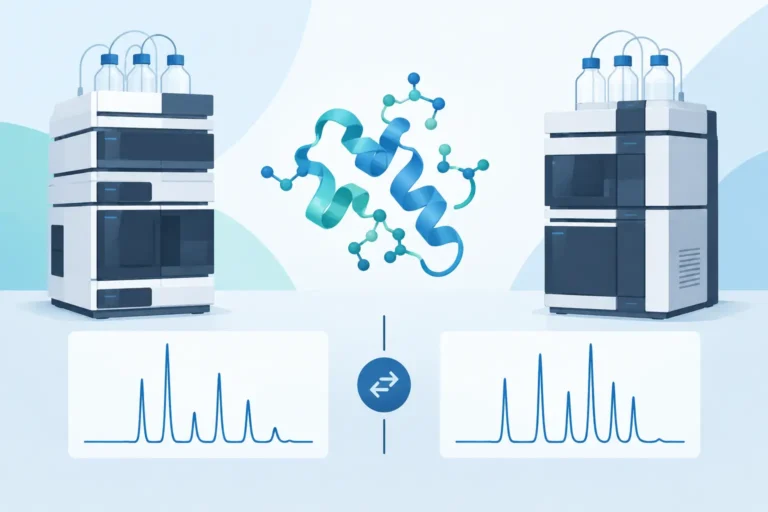
UHPLC purity screening is a central quality measure because it separates components within a sample and estimates the relative abundance of the target peak. A reported purity of 99% or higher can indicate a tightly controlled material profile, provided the method and result apply to the lot in hand.
Still, purity should be read carefully. A chromatographic area percentage does not independently prove that the main peak is the intended peptide. It also does not automatically identify every low-level impurity, establish biological activity, or predict stability after reconstitution. Purity is a quantitative indicator, not a complete characterization program.
Ask whether the COA identifies the analytical platform, the reported purity value, the lot or batch number, and the date of analysis. If these details are absent, the number has limited value in a documented procurement process.
Identity confirmation closes a critical gap
Mass spectrometry provides a complementary identity check. It evaluates mass-to-charge signals expected for the peptide and helps confirm that the material corresponds to its stated molecular mass. When paired with UHPLC, mass spectrometry helps distinguish a clean-looking chromatographic result from a verified target compound.
That pairing matters because peptides are structurally specific research materials. Small sequence errors, truncations, synthesis-related byproducts, or handling mistakes can affect experimental interpretation. Identity confirmation is especially relevant when a project compares closely related peptide structures or tracks subtle concentration-response differences.
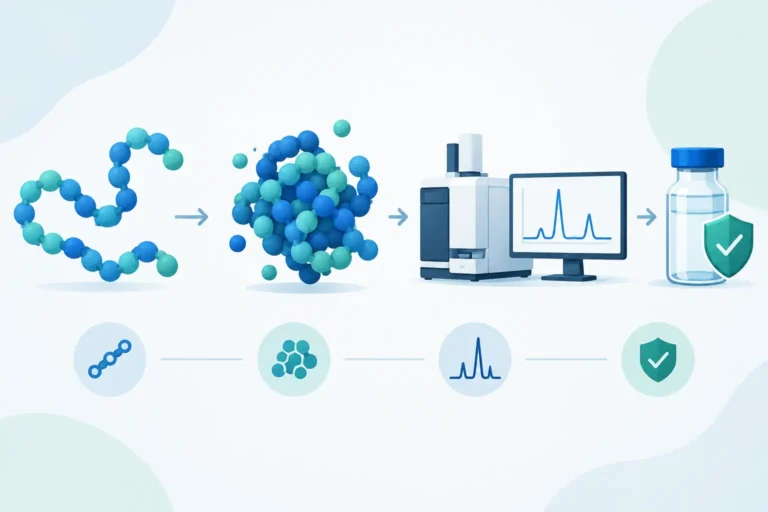
Mass confirmation is not the same as complete sequence mapping, and research teams should avoid treating any single assay as universal proof of every quality attribute. The right analytical depth depends on the study objective. For routine controlled in-vitro work, documented UHPLC and mass-spectrometry results are a strong baseline for supplier qualification.
Endotoxin screening supports cleaner in-vitro conditions
Endotoxin can confound sensitive laboratory systems, particularly where inflammatory signaling, cell response, or assay background may be affected. Endotoxin screening is therefore a meaningful quality-control measure for materials intended for controlled in-vitro investigation.
A reported endotoxin result should be considered alongside the research model and assay sensitivity. Low endotoxin does not make a research material suitable for administration, clinical work, diagnostics, veterinary use, or therapeutic use. It indicates that the supplier has measured a potential laboratory contaminant as part of a defined quality program.
For studies with stringent contamination requirements, researchers should establish their own acceptance criteria before ordering. The correct threshold is assay-dependent, not a marketing claim.
How to Read a Certificate of Analysis
A Certificate of Analysis is useful only when it is specific, traceable, and interpretable. A generic document showing a compound name and a high purity percentage is not equivalent to a batch-level record.
Start by matching the COA to the product label, order record, and lot number. The compound name, unit size, batch identifier, and testing results should align. Next, review whether the certificate states the test method rather than only the conclusion. A result such as “passed” may be insufficient when a research program requires comparable data across multiple lots.
For analytical-grade peptide procurement, a strong COA commonly addresses identity, purity, and relevant contamination screening. Depending on the supplier and material, documentation may also include appearance, net peptide content, water content, residual solvent data, or reconstitution guidance. Not every test is necessary for every application, but unexplained omissions deserve attention when the work is high consequence or highly sensitive.
Researchers should also distinguish between a supplier-generated specification and an independently generated test result. Independent U.S. laboratory testing adds separation between the commercial supplier and the analytical report, which can strengthen confidence in the documentation. Irontide Labs positions batch-level COAs alongside UHPLC purity screening, mass-spectrometry identity verification, and endotoxin screening for this reason: the evidence should be available before a material becomes part of the experimental record.
Match the Material to the Experimental Risk
Not all projects require the same level of characterization. Early feasibility work may prioritize availability, a defined unit size, and baseline identity and purity evidence. A comparative study, a multi-week stability assessment, or a project intended to inform expensive downstream work may require tighter lot controls and more comprehensive internal qualification.
The trade-off is practical. More testing and documentation can increase procurement cost or limit the number of available lots, yet under-characterized material can create a far greater cost if it invalidates a data set. The appropriate decision depends on the consequence of error.
Consider the entire chain of custody as well. A well-tested peptide can lose reliability through unclear storage conditions, repeated freeze-thaw cycles, unsuitable solvent selection, or inaccurate working-solution preparation. Record receipt date, lot number, storage conditions, reconstitution details, and use history in the same system that houses experimental data.
A Procurement Standard That Supports Reproducibility
Before selecting a peptide supplier, research teams should be able to answer four questions: Is the material clearly labeled as research use only? Is there batch-specific evidence for purity and identity? Is contamination screening documented where it matters to the assay? Can the lot be traced from order through experimental use?
These questions are more valuable than vague claims of “premium” or “lab quality.” They turn procurement into an extension of experimental design. They also make it easier to investigate an unexpected result without guessing whether the starting material was characterized appropriately.
Reliable fulfillment plays a supporting role. Clear unit sizes, accessible COAs, account-based order records, and consistent domestic handling help laboratories maintain organized inventory and reduce administrative friction. None of these operational strengths substitute for analytical data, but they make that data more usable when studies span multiple orders or personnel.
Compliance Boundaries Are Part of Quality Discipline
Research-use-only peptide compounds must remain within their stated use boundaries. They are not approved or supplied for human use, veterinary use, clinical use, diagnostic use, therapeutic use, or pharmaceutical use. Analytical testing and a documented COA do not change that status.
This boundary is not boilerplate. It preserves the integrity of the procurement process by ensuring materials are evaluated for their intended controlled in-vitro research context. Researchers should design, handle, store, and dispose of compounds according to institutional procedures, applicable regulations, and laboratory safety requirements.
The strongest analytical grade peptide decision is rarely based on one headline number. It is based on a traceable batch, complementary testing methods, fit-for-purpose acceptance criteria, and disciplined documentation. When those elements are established before ordering, the material becomes a more reliable input and the resulting data becomes easier to trust.