High Purity Versus Crude Peptides Compared
A peptide can match its expected mass and still introduce uncertainty into an experiment. That is the practical difference behind high purity versus crude peptides: the decision affects how confidently a research team can attribute an observed result to the intended compound rather than to closely related synthesis byproducts, residual materials, or an incompletely characterized batch.
For controlled in-vitro research, purity is not a marketing adjective. It is a measurable property with direct implications for assay design, repeatability, procurement risk, and the defensibility of downstream data. It must also be interpreted alongside identity, batch documentation, and the analytical method used to generate the result. You can browse Irontide’s research compounds directly in our catalog.
High Purity Versus Crude Peptides: The Core Difference
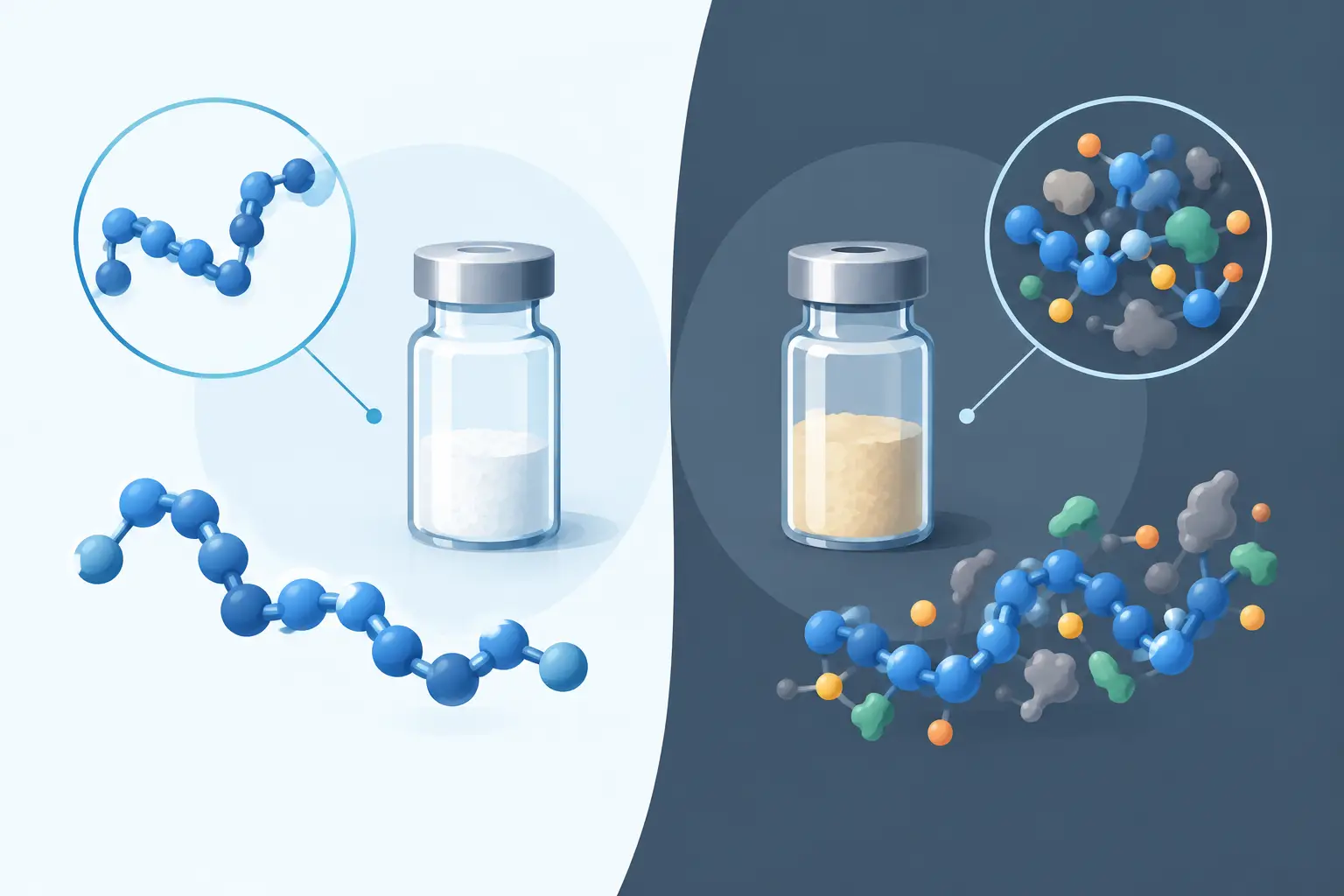
Crude peptide material is the product obtained after synthesis and initial cleavage, before substantial purification. Solid-phase peptide synthesis is highly capable, but it does not produce only one molecular species. Depending on sequence length, amino acid composition, coupling efficiency, and process conditions, a crude preparation may contain deletion sequences, truncated chains, incompletely deprotected material, oxidation products, aggregation-related species, and residual process components.
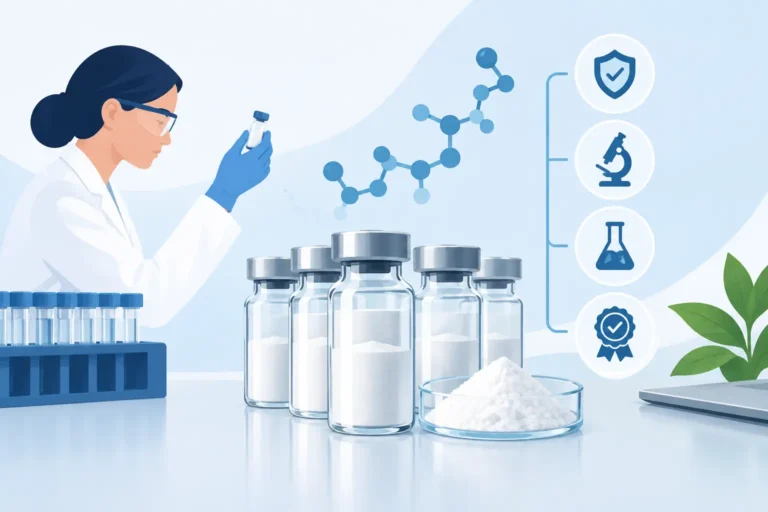
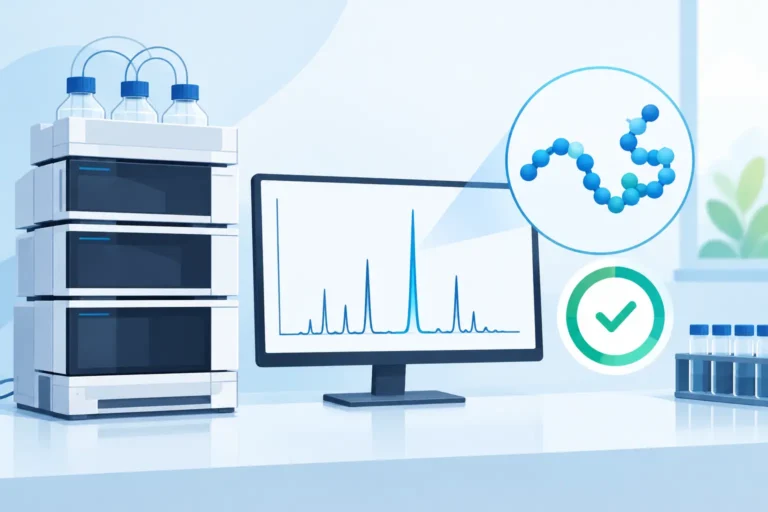
A high-purity peptide has undergone purification intended to enrich the target molecular species and reduce these related impurities. Reversed-phase preparative chromatography is commonly used for this purpose. The resulting material is then evaluated through analytical methods such as ultra-high-performance liquid chromatography, or UHPLC, and mass spectrometry.
The distinction is not simply crude equals unusable and high purity equals automatically suitable for every experiment. Crude material can have a legitimate role in early synthesis evaluation, method development, or internal screening where the research question does not require a highly defined input. High-purity material is generally the more appropriate choice when reproducibility, controlled comparison, sensitive readouts, or documented procurement standards matter.
Why Crude Material Can Complicate Interpretation
The challenge with crude material is not only that it contains less of the intended peptide. It is that the remaining fraction may not be analytically irrelevant. A deletion impurity can share much of the target sequence. A modified analog may elute near the main peak. A non-peptide residual may affect a sensitive cell-based or biochemical system differently from the intended analyte.
That creates an attribution problem. If an assay produces an unexpected response, the investigator must ask whether the observation reflects the target peptide, a related impurity, the combined chemical profile, or variability between lots. With a poorly characterized crude sample, those questions can remain open even when experimental execution was otherwise sound.
This risk increases when working with low concentrations, narrow assay windows, or experiments where small changes in material quality can alter apparent activity, stability, binding, solubility, or background signal. The correct threshold depends on the protocol. A screening workflow and a quantitative characterization study should not necessarily apply the same acceptance criteria.
Purity Percentage Is Useful, but It Is Not the Whole Specification
A reported purity percentage provides an important starting point. For example, a UHPLC result of 99% or higher indicates that the primary chromatographic peak represents the overwhelming majority of the measured signal under the reported method. That is a meaningful quality-control indicator, especially when supported by batch-level documentation.
However, purity percentage should not be treated as a complete statement of fitness for a particular research application. Chromatographic purity does not independently establish molecular identity, concentration accuracy, salt content, water content, microbial status, endotoxin level, or stability after reconstitution. It also depends on the detection conditions and integration approach used by the testing laboratory.
A strong quality evaluation therefore asks several related questions. Does the material show the expected molecular mass? Does the chromatographic profile support the reported purity? Is the batch traceable to a specific certificate? Has endotoxin screening been performed when that attribute is relevant to the research environment? Are the stated unit size, storage conditions, and handling instructions aligned with the laboratory’s planned use?
Purity is one critical control. It is not a substitute for a complete analytical picture.
Identity confirmation addresses a different risk
UHPLC helps characterize separation and relative purity. Mass spectrometry helps confirm that the principal material is consistent with the expected molecular mass. These methods work best as a pair because they address different questions.
A clean chromatographic trace alone does not prove the main peak is the intended peptide. Conversely, an expected mass alone does not show that closely related impurities have been adequately separated or reduced. For research procurement, reviewing both identity confirmation and purity data provides a more defensible basis for accepting a batch.
Endotoxin screening is not interchangeable with purity testing
Endotoxin is not typically resolved by a standard purity claim. A peptide may show high chromatographic purity while requiring separate evaluation for endotoxin, depending on the nature of the work and laboratory controls. Treating all quality attributes as though they are captured by one percentage can leave a major gap in the material assessment process.
For this reason, serious research programs define quality requirements by application rather than relying on a single headline specification. The objective is not to accumulate certificates. It is to select evidence that addresses the sources of variability most likely to compromise the intended experiment.
When High Purity Is the Better Research Decision
High-purity peptide material is generally the stronger choice when the peptide is a central experimental variable rather than a preliminary input. It supports cleaner comparisons across runs, clearer lot-to-lot qualification, and more credible interpretation when results are shared internally or developed into future work.
It is particularly valuable for controlled in-vitro investigations involving mechanistic characterization, dose-response design, stability assessment, receptor or pathway studies, and analytical method validation. In these settings, a material profile dominated by the intended peptide reduces one avoidable source of uncertainty. It does not eliminate all experimental variables, but it makes the chemical input easier to control.
There is also an operational advantage. When a supplier provides a batch-specific Certificate of Analysis with UHPLC purity screening, mass-spectrometry identity verification, and applicable endotoxin results, the procurement team has a documented record to connect with inventory, protocol notes, and experimental output. That traceability matters when a team needs to investigate an anomalous result months later.
At Irontide Labs, the quality position is built around independently tested, research-use-only peptide compounds, with documented batch information and U.S.-based quality-control expectations. The objective is straightforward: provide researchers with material evidence that supports controlled, non-clinical laboratory investigation.
When Crude Peptides May Be Appropriate
Crude peptides can be reasonable when the experimental purpose is limited and clearly defined. A research group evaluating whether a new sequence can be synthesized, testing a purification workflow, or conducting broad internal triage may not require the same purity standard as a study built around quantitative conclusions.
The trade-off is that the laboratory should recognize crude material as a mixed preparation and design accordingly. That may mean avoiding fine-grained claims, separating synthesis screening from confirmatory work, and reserving higher-purity lots for experiments where data quality must withstand comparison or repetition.
Cost is often part of this decision. Crude material may reduce the initial expense of evaluating a sequence, while purification and analytical verification add time and cost. But the lower purchase price can become expensive if ambiguous results trigger repeated experiments, consume scarce assay capacity, or prevent meaningful comparisons between lots. The appropriate choice depends on the value of the decision the experiment is meant to support.
What to Review Before Accepting a Peptide Batch
A Certificate of Analysis should be read as a decision document, not a decorative attachment. Start by confirming that the compound name, batch or lot identifier, and stated amount match the material being received. Then review the reported purity method, chromatogram or purity result where provided, mass-spectrometry identity data, and any separate endotoxin screening information relevant to the protocol.
Next, consider what the document does not establish. If the experiment requires a specific solvent system, concentration range, reconstitution procedure, or storage duration, those parameters still require laboratory-level planning and verification. A high-quality incoming material does not replace appropriate controls, qualified instrumentation, or sound experimental design.
Researchers should also preserve the link between the physical vial, the batch documentation, and the experiment. Record receipt condition, storage location, reconstitution details, and any observed changes during handling. This level of discipline turns supplier documentation into usable traceability rather than a file that is reviewed once and forgotten.
Set the Standard Before the Experiment Starts
The best time to decide between crude and high-purity peptide material is before assay conditions are locked. Define what must be known about the input material for the resulting data to be interpretable, then procure to that standard. For exploratory work, crude material may answer an early question efficiently. For controlled research where reproducibility and attribution matter, high purity supported by identity confirmation and batch-level documentation is the more disciplined foundation.
The goal is not to purchase a number on a label. It is to reduce uncertainty where uncertainty is most likely to distort the research question, and to keep every conclusion within the limits of material characterization and research-use-only handling.