
Peptide Characterization for Defensible Research
A peptide vial can look identical to another vial while producing materially different experimental conditions. Peptide characterization is the work that turns an unverified material into a documented research input: one with an established identity, measured purity profile, and batch-specific quality record. For controlled in-vitro investigation, that distinction is not administrative. It is part of the experimental design.
When a result is unexpected, researchers need to separate biological signal from material uncertainty. A defined characterization package does not guarantee a biological outcome, but it gives the research team a defensible starting point. It establishes what was tested, how it was assessed, and whether the supplied batch meets the quality specifications required for the intended non-clinical work. You can browse Irontide’s research compounds directly in our catalog.
What Peptide Characterization Must Establish
At its core, characterization addresses three connected questions: Is this the intended molecule? How much of the sample is the intended molecule relative to detectable impurities? And can the laboratory trace those answers to the specific batch in hand?
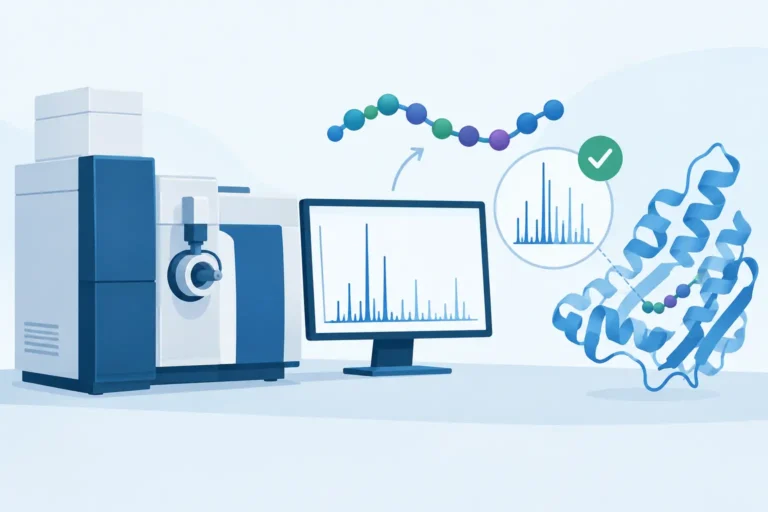
Identity confirmation is the first threshold. For peptides, molecular mass provides a highly useful identity marker because the expected amino acid sequence and associated modifications produce a defined theoretical mass. Mass spectrometry compares the observed mass signal with that expected molecular profile. The result supports qualitative confirmation that the material corresponds to the specified peptide rather than an unrelated compound.
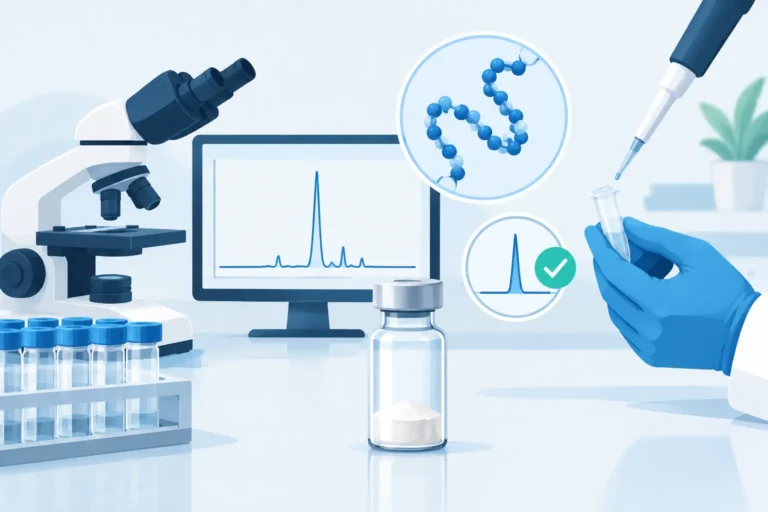
Purity answers a different question. A sample can produce the expected mass signal and still contain process-related impurities, deletion sequences, oxidation products, residual synthesis components, or degradation products. Ultra-high-performance liquid chromatography, commonly reported as UHPLC, separates sample components and measures the relative chromatographic profile. A high reported purity percentage indicates that the principal peak accounts for the stated portion of the measured signal under the test method.
Traceability connects the analytical result to procurement and use. A Certificate of Analysis should identify the batch or lot, product name, test methods, specifications, results, and relevant release information. Without lot-level documentation, a purity claim is a marketing statement. With it, the claim becomes an auditable data point that can be reconciled with receiving records, study files, and retained samples.
Why One Test Is Not Enough
No single method fully characterizes a peptide. Each analytical technique answers a narrower question, and a credible quality position comes from interpreting the methods together.
Mass spectrometry is highly effective for identity confirmation, but it does not independently describe the full impurity landscape. UHPLC creates separation data that helps reveal purity and related components, yet chromatographic purity alone does not prove molecular identity. Endotoxin screening evaluates a separate contamination risk relevant to sensitive in-vitro systems, particularly where unwanted endotoxin exposure could confound cellular responses.
This is why a documented testing framework often includes UHPLC purity screening, mass-spectrometry identity verification, and endotoxin screening. Depending on the material and research application, concentration analysis, water content, residual solvent testing, peptide content, or stability assessment may also be relevant. The appropriate panel depends on the research question, matrix, storage conditions, and degree of assay sensitivity.
A reported result also needs context. A 99% UHPLC purity result is valuable, but it is not interchangeable with a claim of 99% peptide content by weight. Chromatographic area normalization, assay value, and net peptide content measure related but different attributes. Researchers should read the reported method and result label carefully rather than treating every percentage as the same measurement.
Reading a COA Like a Research Document
A Certificate of Analysis is most useful when it can be read alongside the experimental plan. Start by confirming that the product name, lot number, and package information match the material received. Next, review the specification and actual result for each listed test. A result without a specification gives less information about the supplier’s release standard; a specification without a batch result does not document the material in hand.
For identity, look for a stated mass-spectrometry method and a result that indicates agreement with the expected molecular mass or identity criterion. For purity, look for the chromatographic method, the stated percentage, and the acceptance threshold. If endotoxin screening is listed, confirm that the result is expressed in a meaningful unit and is evaluated against a defined limit.
Method transparency matters because results are method-dependent. A chromatogram generated under one set of mobile phases, detection wavelengths, and integration parameters may not be directly comparable with a result from another laboratory. That does not make one result invalid. It means the COA should be treated as a record of a specific analytical procedure applied to a specific lot.
The strongest procurement practice is to preserve the COA with the study documentation and record the lot used in each experiment. This creates continuity when repeating work, transferring a method, comparing results over time, or investigating an anomaly. Batch-level data gives the team a factual basis for deciding whether variation is more likely tied to the material, the assay, or the experimental system.
Characterization Begins Before the Vial Arrives
Quality review should start at supplier qualification, not after an experimental run has failed. Research procurement teams should define which evidence is required for a material category before placing an order. For sensitive peptide work, that baseline commonly includes independent testing, lot-specific COA access, chromatographic purity data, molecular identity confirmation, and clear research-use-only boundaries.
Domestic testing and fulfillment can improve operational control, especially when timelines are tight and documentation must be reviewed before a study begins. It does not replace laboratory evaluation, but it can reduce avoidable friction around batch records, shipment tracking, and quality inquiries. A supplier should be able to state what is tested, how results are documented, and which batch those results represent.
Storage and handling are part of characterization continuity. A well-characterized peptide can still become unsuitable if it is exposed to inappropriate temperature, moisture, repeated handling, or incompatible solvent conditions. Receiving procedures should verify packaging integrity and lot identification, then align storage and preparation with the material documentation and the laboratory’s validated practices.
For long-running studies, consider retaining a controlled reference aliquot where appropriate. If an unexpected result emerges later, the retained material can support a more disciplined investigation. This is particularly useful when experiments involve low concentrations, highly responsive cell systems, or comparisons across multiple batches.
Matching the Evidence to the Research Risk
Not every project requires the same depth of characterization. A preliminary screen and a high-stakes mechanistic comparison do not carry identical risk. The key is to avoid under-characterizing the material relative to the decision that will be made from the data.
If the work is exploratory, documented identity and high-purity UHPLC screening may establish a practical baseline. If the goal is to compare subtle pathway effects, quantify small shifts in response, or support reproducibility across sites, additional attention to impurity profiles, peptide content, endotoxin status, stability, and lot-to-lot consistency becomes more consequential.
Researchers should also resist treating a COA as a substitute for method development. The COA verifies defined material attributes at release. It does not validate reconstitution, confirm the concentration prepared in a local laboratory, or establish stability in a particular assay medium. Those questions belong to the research workflow and should be evaluated under the conditions that matter to the study.
Irontide Labs positions its research-use-only materials around independently verified U.S. testing, UHPLC purity screening, mass-spectrometry identity confirmation, endotoxin screening, and accessible batch documentation. These controls are designed for qualified researchers conducting controlled in-vitro work, not for human, veterinary, clinical, diagnostic, therapeutic, or pharmaceutical use.
The practical standard is straightforward: before a peptide enters an experiment, the team should be able to identify the batch, explain the evidence behind its identity and purity, and preserve that evidence with the resulting data. That discipline makes every later research decision easier to defend.