Peptide Sequence Confirmation Workflow Explained
A peptide sequence confirmation workflow is not a single instrument run or a purity number on a report. It is a controlled chain of evidence used to establish that a research material is consistent with the intended amino acid sequence, molecular form, and batch specification before it enters an in-vitro study. When sequence identity is assumed rather than documented, an apparently minor substitution, deletion, oxidation event, or synthesis-related impurity can alter the interpretation of every result that follows.
For research teams evaluating peptide materials, the central question is straightforward: does the evidence support the identity of the material in the vial? Answering it well requires orthogonal analytical methods, clear acceptance criteria, and batch-specific documentation. It also requires understanding what each method can prove – and where its limits begin. You can browse Irontide’s research compounds directly in our catalog.
Why Peptide Identity Requires More Than a Purity Result
UHPLC purity screening and sequence confirmation answer related but different questions. UHPLC separates components in a sample and estimates the relative abundance of the primary peak under defined conditions. A result at or above a specified purity threshold is meaningful quality evidence, but it does not independently establish the full amino acid order of that peak.
A high-purity sample can still be the wrong sequence, a truncated sequence, or a peptide carrying a modification that was not intended. Closely related impurities may also co-elute under a particular chromatographic method. For that reason, purity should be considered one component of identity confirmation, not a replacement for it.
Mass spectrometry adds a different layer of evidence. Intact-mass analysis can confirm whether the observed molecular mass aligns with the expected mass of the target peptide. This is a strong first identity check and can reveal large discrepancies, unexpected adducts, incomplete deprotection, or certain modifications. But peptides with the same elemental composition can share the same intact mass. Isomeric residues and some sequence rearrangements may not be resolved by intact-mass data alone.
The practical standard is an evidence package in which chromatography, accurate mass, and sequence-informative fragmentation work together. The more consequential the study, the more valuable that layered approach becomes.
The Peptide Sequence Confirmation Workflow
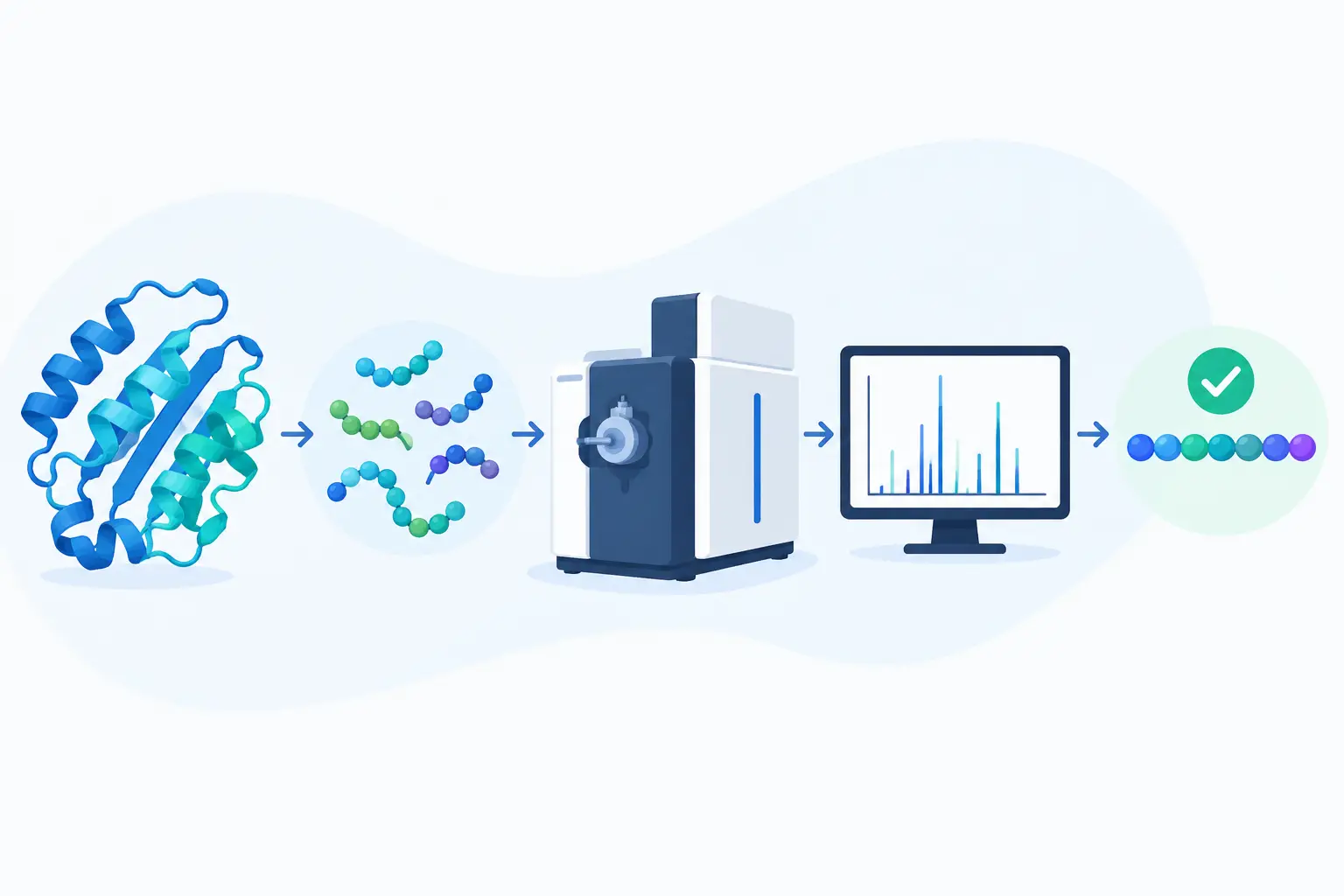
A disciplined workflow begins before analysis. The expected sequence must be defined precisely, including N-terminal and C-terminal forms, intended modifications, disulfide state where applicable, salt form, and expected molecular mass. If the target definition is incomplete, the analytical result cannot be interpreted with confidence.
Step 1: Establish the reference specification
The laboratory records the full target sequence using a consistent notation and calculates the theoretical monoisotopic mass. Expected charge states, relevant adducts, and known liabilities should be considered at this stage. Methionine oxidation, deamidation at susceptible residues, disulfide scrambling, and terminal alterations can complicate interpretation if they are not anticipated.
This step also sets acceptance criteria. A sample may be expected to show an intact mass within a defined tolerance, a primary UHPLC peak at or above the required area percentage, and sufficient fragment-ion coverage to distinguish the intended sequence from meaningful alternatives. Criteria should be appropriate to the peptide’s length, composition, and research purpose. There is no single threshold that fits every analyte.
Step 2: Screen the material by UHPLC
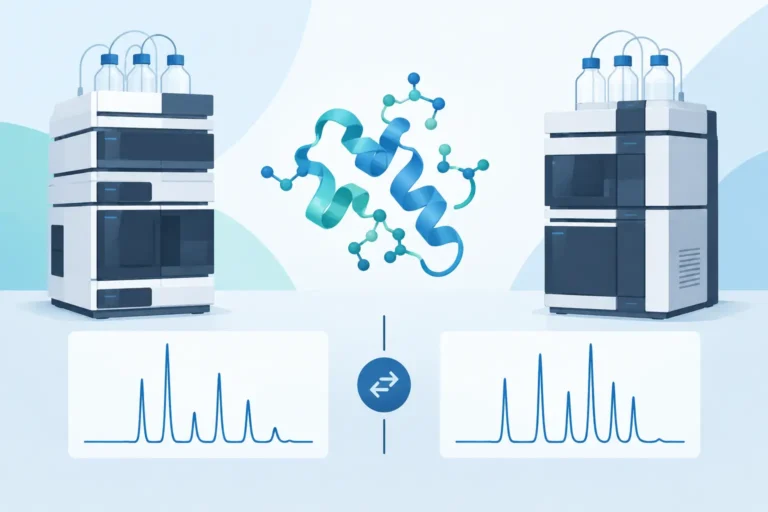
UHPLC evaluates the chromatographic profile of the peptide preparation. The primary peak, retention behavior, peak shape, and detectable secondary peaks provide an immediate view of sample complexity. A clean profile supports consistency, while shoulders, broad peaks, or unexpected secondary peaks may indicate synthesis byproducts, degradation, aggregation, or sample-handling issues.
Chromatographic purity is especially useful for comparing batches under the same method. It helps research teams assess whether the material is compositionally consistent enough for controlled in-vitro work. Still, a chromatogram should always be read alongside identity data. One dominant peak is not a sequence assignment.
Step 3: Confirm intact molecular mass
The intact peptide is analyzed by mass spectrometry, often with deconvolution of multiple charge states to obtain a neutral molecular mass. The observed value is compared to the theoretical value derived from the reference specification.
A matching mass supports the proposed identity, but interpretation requires care. Sodium or potassium adducts, solvent associations, counterions, and oxidation products can create additional signals. Charge-state assignment must be credible, and the reported mass tolerance should match the capabilities of the instrument and method.
For short, well-characterized peptides, intact mass plus chromatographic purity may provide strong routine release evidence. For a more definitive sequence claim, particularly where positional isomers or sequence-related impurities are plausible, tandem mass spectrometry is the decisive next layer.
Step 4: Generate sequence-informative fragments
Tandem mass spectrometry, commonly described as MS/MS, isolates a peptide ion and fragments it to produce product ions. These fragment ions can be assigned across the backbone to generate b- and y-ion series. Together, they provide evidence for the order of residues within the peptide.
Fragment coverage matters more than a simple statement that MS/MS was performed. Analysts evaluate whether the observed ions support the sequence across informative regions, including areas where likely substitutions, deletions, or modifications would be distinguishable. Gaps can occur because some sequences fragment unevenly, so the goal is not always complete coverage. The goal is sufficient discriminating evidence for the claimed identity.
Method selection depends on the analyte. Collision-based fragmentation may work well for many peptides, while alternative fragmentation approaches can preserve or better localize labile modifications. Disulfide-containing peptides may require reduction, alkylation, enzymatic digestion, or a specialized mapping strategy. Each preparation choice creates a trade-off between simpler interpretation and preservation of the original molecular form.
Step 5: Review modifications and sequence-related variants
A sequence confirmation workflow should actively look for plausible alternatives rather than only seeking evidence that supports the target. This includes common synthesis-related variants such as deletion sequences, incomplete coupling products, terminal truncations, and epimerization risk where relevant.
It should also account for chemical changes introduced during storage or handling. Oxidation, deamidation, hydrolysis, and disulfide exchange can affect both the chromatographic profile and biological behavior in an experimental system. A material may have met release specifications at manufacture yet require reassessment if its storage history, appearance, or analytical profile raises questions.
This is where orthogonal data protects research integrity. An unexpected peak may be investigated by mass spectrometry, while an unexpected mass shift may be traced back to chromatographic separation and fragment-ion evidence. No individual technique carries the entire burden of proof.
Documentation Is Part of the Analytical Result
For procurement and laboratory operations, traceability is not administrative overhead. It is part of the quality system. A useful Certificate of Analysis identifies the product, lot or batch, test methods, reported results, specifications, and release status. It should allow a research team to connect the material received with the evidence reviewed before use.
Batch-level documentation is particularly valuable when studies extend over time or require repeat procurement. If experimental findings need to be compared across lots, researchers need a clear record of which material was used, what testing was performed, and whether the analytical profile was consistent with the defined specification.
At Irontide Labs, independent U.S. testing, UHPLC purity screening, mass-spectrometry identity verification, endotoxin screening, and accessible batch documentation are positioned to support this chain of evidence for research-use-only materials. These controls do not convert a peptide into a clinical, diagnostic, veterinary, therapeutic, or pharmaceutical product. They help qualified researchers make better-informed decisions for controlled in-vitro investigation.
Common Gaps That Undermine Confidence
The most common failure is treating a single result as complete proof. A purity percentage without identity data cannot establish sequence. An intact-mass match without fragmentation may not distinguish certain isomeric or rearranged sequences. A generic statement that a product was “tested” provides little value without method context and batch-specific results.
Another gap is confusing analytical confirmation with stability confirmation. Identity testing establishes what was present in the tested sample at a defined time. It does not automatically demonstrate that the material will remain unchanged under every storage, reconstitution, or experimental condition. Stability questions require their own controlled protocols, time points, and acceptance criteria.
Finally, researchers should avoid overinterpreting a COA outside its scope. The document should be evaluated for what it reports, the lot it covers, and the analytical methods used. Responsible procurement means matching the evidence to the intended research application rather than relying on marketing language alone.
Build Confidence Before the Experiment Starts
A defensible peptide sequence confirmation workflow connects a precise reference specification with UHPLC assessment, intact-mass verification, sequence-informative MS/MS, and batch-level documentation. The result is not simply a pass or fail label. It is a transparent analytical rationale for why a material is suitable to enter a defined research process.
Before a peptide reaches the bench, review the evidence with the same discipline you will apply to the experiment itself. Clear identity confirmation cannot guarantee a discovery, but it can prevent an uncertain starting material from becoming an avoidable source of uncertain data.