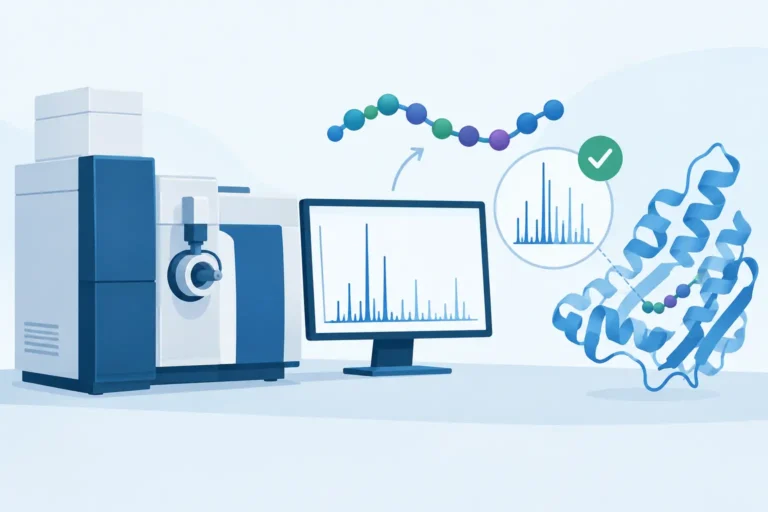

Peptide COA Review Checklist for Research Buyers
A vial label can identify a compound. A Certificate of Analysis must establish whether that specific batch is suitable for controlled in-vitro work. This peptide COA review checklist is built for researchers and procurement teams who need documented evidence before a material enters a workflow, not broad marketing claims after an order is placed.
For research-use-only peptides, the COA is a batch-level quality record. It should connect the material in hand to defined analytical methods, measurable acceptance criteria, and a traceable testing record. When that chain is incomplete, a stated purity percentage has limited value. For qualified research teams seeking batch-verified reference standards with complete analytical documentation, you can browse Irontide’s research compounds directly in our catalog.
Why COA Review Belongs Before Procurement
Peptide research can be sensitive to small differences in identity, impurity profile, concentration, handling history, and contamination risk. A material that is poorly characterized may introduce variables that are difficult to identify after an experiment has begun. That can compromise comparability between runs, consume limited samples, and complicate interpretation of in-vitro results.
A credible COA does not eliminate every research variable. It does provide the documentation needed to assess the material before use and to maintain a defensible record of what was procured. The strongest review process considers both the result and the method used to produce it.
Purity, for example, is not a complete proxy for identity. A high chromatographic purity result does not independently prove molecular mass, sequence-related identity, net peptide content, or endotoxin status. Each of those questions requires its own evidence.
Peptide COA Review Checklist: The Core Records
Use the following checkpoints as a procurement screen. The exact tests needed depend on the compound, intended in-vitro workflow, and internal quality requirements, but these records establish a strong baseline.
- Match the product name and batch or lot number. The compound name, vial strength or unit size, and lot number should align across the product label, COA, order record, and any accompanying packaging documentation. A COA that cannot be tied to the physical batch is not batch-level evidence.
- Confirm the supplier and testing source. Identify who issued the COA and whether analysis was completed by an independent laboratory, the supplier’s internal quality team, or both. Independent testing can add meaningful separation between manufacturing claims and analytical verification. The document should identify the laboratory or responsible testing entity clearly enough for procurement records.
- Review the issue date and testing date. A report should show when the batch was tested and when the certificate was issued. These dates help establish document currency and support inventory traceability. They are not, by themselves, a stability claim or an expiration determination.
- Verify molecular identity by mass spectrometry. Mass spectrometry is central to identity confirmation because it evaluates the observed mass against the expected molecular mass. Review whether the report provides an expected value, observed value, tolerance or error, and a clear pass determination. A generic statement such as “identity confirmed” is weaker than a result that shows what was measured.
- Assess purity by UHPLC or HPLC. The report should name the chromatographic method and state the purity result for the tested batch. For high-purity research materials, UHPLC screening offers high-resolution separation of peptide-related components. Ask whether the value is based on peak-area normalization, whether a chromatogram is available, and whether the reported main peak is consistent with the expected analyte.
- Check the specification, not only the result. A reported result means more when it is evaluated against a stated acceptance criterion. For example, a certificate may list a purity specification of at least 99% and show the measured result for that lot. The same logic applies to identity, endotoxin, and any quantitative assay.
- Look for endotoxin screening when relevant. Endotoxin can be a consequential variable in sensitive cell-based research. If endotoxin control matters to the planned model, verify that the COA states the test method, result, unit of measure, and applicable specification. “Endotoxin tested” without a numerical result provides less decision-grade information.
- Confirm document control and authorization. The COA should include a certificate number, version or revision information where applicable, and authorization by the responsible laboratory or quality function. These details matter when records are retained, audited internally, or compared across repeat purchases.
Read UHPLC Purity Results With Precision
A purity result is often the first figure a buyer sees. It should never be the last.
UHPLC or HPLC purity commonly reflects the relative area of the principal chromatographic peak under defined conditions. That measurement is valuable for assessing chromatographic purity, particularly when supported by a clear method and chromatogram. Still, it may not directly represent absolute peptide content by weight. Residual water, counterions, salts, or other non-chromophoric material can affect what is present in a vial without being fully explained by a peak-area purity number.
This distinction matters when a workflow depends on tightly controlled concentration preparation. A 99% chromatographic purity result can indicate a clean chromatographic profile, while net peptide content may require separate quantitative analysis. If absolute content is a critical experimental variable, determine whether the supplier provides an assay or quantitative analysis appropriate to that requirement.
Chromatograms should also be read with context. A dominant main peak is encouraging, but minor peaks deserve attention when the application is impurity-sensitive. Retention time, detection wavelength, integration approach, column conditions, and method suitability all influence interpretation. A COA need not reproduce a full analytical validation package to be useful, but it should provide enough method context to prevent a purity claim from standing alone.
Confirm Identity Beyond a Product Label
Mass spectrometry answers a different question than chromatography: is the measured molecular mass consistent with the expected compound? For peptide procurement, that distinction is fundamental.
Review the expected molecular weight and observed mass, then determine whether the reported deviation falls within the laboratory’s stated tolerance. Where charge states, adducts, or deconvoluted masses are presented, the document should make the result understandable to a technically qualified reviewer. A mass result without an expected comparator is less informative than a direct expected-versus-observed record.
Identity confirmation also has limits. Intact-mass confirmation can strongly support the intended molecular composition, but it may not resolve every positional isomer, sequence-related impurity, or stereochemical question. The appropriate level of characterization depends on the research question. For routine controlled in-vitro work, UHPLC plus mass spectrometry is often a practical, high-value foundation. For highly specialized analytical studies, additional characterization may be warranted.
Examine Endotoxin Data in the Context of the Model
Endotoxin screening is not merely a checkbox for every research program. Its relevance depends on the biological system, experimental controls, and tolerance for inflammatory or stress-related confounding effects in the model.
When endotoxin data is required, confirm that the result is expressed in a recognizable unit, such as endotoxin units per mass or per vial, and that the COA names the method or test platform. A pass/fail statement can support a specification, but a numerical result provides more useful information for internal risk assessment.
Do not infer sterility, suitability for administration, or clinical quality from an endotoxin result. Endotoxin screening is a specific analytical control. It does not convert a research material into a human, veterinary, diagnostic, therapeutic, or pharmaceutical product.
Build Traceability Into Your Receiving Process
COA review should continue when the shipment arrives. Compare the physical vial label and outer packaging against the order confirmation and certificate before the material is entered into inventory. Record the lot number, receipt date, storage condition on arrival, and location in the laboratory’s inventory system.
For multi-user labs, retain the COA with the batch record or digital inventory entry rather than storing it only in an individual purchaser’s inbox. If multiple vials from the same lot are used across projects, that record becomes the link between results and the material tested.
At Irontide Labs, batch-level COA access, independent U.S. laboratory testing, UHPLC purity screening, mass-spectrometry identity verification, and endotoxin screening are designed to give qualified research buyers a clearer quality record before procurement. Review the documentation against the needs of the specific study rather than applying one acceptance standard to every compound and model.
Questions to Ask When a COA Is Incomplete
A missing detail does not always mean the material is unacceptable. It does mean the procurement decision carries more uncertainty. Start by asking whether the COA is specific to the lot being offered and whether supporting data can clarify the gap.
If purity is reported without method information, request the analytical platform, specification, and chromatographic evidence. If identity is claimed without an observed mass, ask for the expected and observed values. If endotoxin is relevant but absent, determine whether screening was performed and whether the result is available for that lot.
The right response depends on the study. A preliminary, non-sensitive analytical exercise may have different documentation needs than a cell-based program that requires tight batch-to-batch control. What should remain consistent is the standard: do not treat undocumented assumptions as verified quality attributes.
A well-reviewed COA does more than support a purchase decision. It gives your team a defined starting point for controlled research, clearer batch records when results are reviewed, and fewer avoidable questions when the work needs to be repeated.